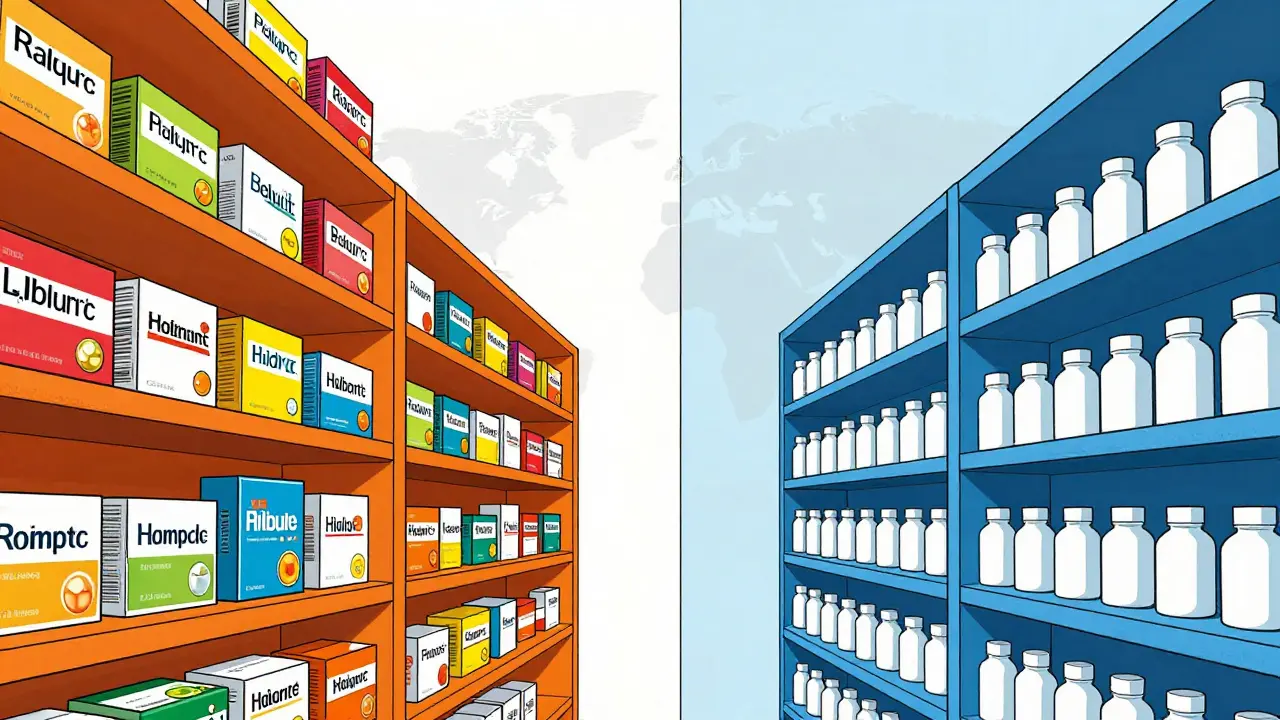
Have you ever wondered why the same medicine costs $50 in one city and $500 in another? It is not just about local taxes or shipping fees. The global market for medication is split into different systems that change how much we pay at the pharmacy counter. While some nations cap prices tightly, others let market forces run wild.
In 2026, this gap remains a major topic of debate. Recent reports show that Pharmaceutical Pricing varies wildly depending on where you live. Depending on the study, American patients can pay anywhere from twice to three times more than their peers in Europe or Asia for brand-name treatments. But the story gets complicated when you look beyond the sticker price.
Quick Summary / Key Takeaways
- The U.S. has significantly higher list prices for brand-name drugs compared to other developed nations.
- Net prices, which account for rebates and discounts, often tell a different story than retail shelf prices.
- Generic drugs make up 90% of U.S. prescriptions but cost less than similar medicines abroad.
- Policy tools like reference pricing and direct negotiation help lower costs in countries like Australia and Japan.
- The Inflation Reduction Act is starting to shift how Medicare negotiates these costs.
The Staggering Gap Between Nations
When we talk about drug costs, the numbers often depend on which study you read. A report from the U.S. Department of Health and Human Services looked at 33 Organisation for Economic Co-operation and Development (OECDcountries) nations. They found that gross prices in the U.S. were 278 percent of prices elsewhere. For brand-name originator drugs specifically, U.S. prices reached 422 percent of international averages.
However, a July 2024 analysis by the University of Chicago flipped the script slightly. Their researchers found that U.S. public-sector prescription net prices are actually 18 percent lower on average than peer countries when looking at six developed nations including Canada, Germany, and the United Kingdom. Why the difference? It comes down to what counts as a transaction. Are we counting the box price on the shelf, or the money exchanged after insurance rebates?
This isn't just academic trivia. It affects whether families skip doses because they cannot afford them. In almost half of the cases analyzed by the Health System Tracker in late 2023, Medicare's negotiated prices exceeded international prices by over three times. One example involved Jardiance, where the U.S. price was nearly four times the average of 11 other nations.
| Region | Average Price Index | Typical Market Behavior |
|---|---|---|
| Western Pacific | Lowest (132.1) | Strict government controls |
| European Region | Moderate (138.7) | External Reference Pricing |
| Americas | Highest (165.3) | Negotiated Rebates |
The Americas region consistently showed the highest median index in a 2024 cross-sectional study analyzing 72 global markets. When you adjust for purchasing power parity, prices in Argentina were roughly 5.8 times higher than in Germany, while Lebanon sat at the opposite end of the spectrum. This tells us that economic stability and healthcare infrastructure play huge roles in final costs.
List Price Versus Net Price: The Core Confusion
Understanding the difference between these two terms is critical to understanding why headlines contradict each other. The list price is what you see printed on the bottle or the invoice. It is rarely what the pharmacy keeps. Manufacturers offer massive rebates to insurance companies and Pharmacy Benefit Managers (PBMs).
Researchers note that brand-name drugs constitute only 7 percent of U.S. prescription sales volume. If you only compare list prices, you focus mostly on those high-cost brand drugs. However, generics represent 90 percent of U.S. prescription volume but only 41 percent in comparison countries. Because unbranded generics are cheaper in the U.S. (at 67 percent of international prices), the overall spending picture changes when volume-weighted net prices are used.
Professor Tomas Philipson from the University of Chicago argued that the U.S. pattern is efficient. It balances affordability through low-cost generics with innovation incentives through higher-priced branded drugs. Others disagree, citing the burden on cash-paying patients who do not have access to these bulk rebates. The discrepancy highlights a structural flaw: if you buy cash, you pay the full list price. If you have commercial insurance, the PBM captures the discount.
Where Do You Actually Pay Less?
If you travel abroad, you will notice the price tag often changes. France and Japan generally have the lowest prices among OECD countries for all drug categories according to multiple studies. Australia also frequently ranks low for specific anticoagulants like Eliquis and Xarelto.
Conversely, Canada, Germany, and the United Kingdom tend to have higher prices across subsets despite having national health strategies. Even there, policies differ. European countries predominantly utilize reference pricing systems. This means if Drug A exists in the same therapeutic class as Drug B, the government sets a maximum reimbursement rate. Pharmacists must charge the patient any difference above that cap.
In contrast, the United States historically relied on private negotiations until the Inflation Reduction Act of 2022 changed the rules. Before this legislation, Medicare could not negotiate directly with drugmakers. Now, the program announces lists of selected drugs for negotiation. The first batch, released in 2023, included ten specific high-cost medications. These new prices implemented in 2025 show significant cuts compared to previous years.
How Governments Control Costs
Different nations use different levers to manage the budget. Most successful interventions involve some form of price control. External reference pricing allows a country to set a price for a drug based on the average price of that drug in a basket of other countries.
This approach works well in stable markets but faces challenges when supply chains get disrupted. China's national drug negotiation policy, for example, effectively reduced prices for certain high-value medications recently. By leveraging its massive population, China creates leverage that smaller nations cannot match alone.
Pricing mechanisms matter more than market size alone. Some analysts use complex indices like the Laspeyres or Paasche indices to track changes over time. These statistical methods account for shifts in consumption patterns. Studies show that Australia, Brazil, and Canada often exhibit higher Paasche indices than Laspeyres indices. This suggests that the types of drugs people buy are changing, potentially moving toward higher-cost treatments as they become available.
The Role of Generic Medicines
You cannot understand global pricing without discussing generics. When a patent expires on a popular medication, competition drives the price down dramatically. In the U.S., this drop is sharper than anywhere else because many competitors flood the market immediately.
For a patient managing chronic conditions, this is good news. However, for the pharmaceutical industry, the timeline of profitability shortens. Companies argue that high prices for new innovations fund the research for future generics. The trade-off is clear: higher upfront costs for new drugs versus long-term savings once patents expire.
In 2022, Ozempic ranked sixth among top selling Medicare Part D drugs, with total spending reaching $4.6 billion. Its popularity illustrates how high list prices for blockbuster medications drive overall expenditure concerns. Even with discounts, the volume is so large that the aggregate cost is astronomical.
What Changes Are Coming?
Looking forward, the landscape is shifting. The IQVIA Institute forecasts that medicine spending will grow between 5-8 percent on a list price basis over the next five years. Even after accounting for rebates, net prices are still expected to rise between 3-6 percent. This indicates continued pressure on health budgets everywhere.
Medicare is required to release new lists for negotiation every year under current law. With the February 1 deadline approaching for subsequent rounds, patients and providers are watching closely. The goal is to stabilize out-of-pocket expenses before inflation catches up with wages.
Despite variations, the consistent finding across methodologies is that the United States maintains significantly higher prices for branded pharmaceuticals while simultaneously achieving lower prices for generic medications. As we move through 2026, the focus remains on whether policy can successfully close the gap between net prices paid by insurers and prices paid by individuals.
Why are drug prices higher in the U.S. than in other countries?
Prices are higher largely due to a lack of centralized price negotiation. Unlike countries that set caps or use reference pricing, the U.S. relies on private payer negotiations, leading to higher list prices for brand-name drugs.
Does the U.S. pay more for generic medications?
No, unbranded generics are typically cheaper in the U.S. compared to international peers. They account for 90 percent of prescriptions in the U.S., helping to lower the average net price overall.
What is the Inflation Reduction Act doing for drug costs?
Passed in 2022, it allows Medicare to negotiate prices for select high-cost drugs. This marks a historic shift from private negotiations to direct federal intervention on specific medications.
Which country has the lowest drug prices?
According to recent OECD data, France and Japan generally rank among the lowest for both brand-name and generic drugs. Australia also has very competitive pricing for certain classes.
How does rebates affect what I pay?
Rebates reduce the net price for insurers and PBMs but do not always lower your copay. If you pay cash without insurance, you often face the full list price unaffected by these hidden discounts.