
DOAC Dosing Calculator for Obesity
Patient Assessment
Results
Enter patient weight and height to see dosing recommendations
When you’re managing blood thinners for someone with obesity, standard dosing doesn’t always mean safe or effective - but it often is. For years, doctors avoided using direct oral anticoagulants (DOACs) in patients with high body weight, worried the drugs wouldn’t work or would cause dangerous bleeding. That fear wasn’t based on science - it was based on absence of data. The original clinical trials for DOACs like apixaban, rivaroxaban, dabigatran, and edoxaban barely included people with BMI over 40 or weight over 120 kg. Now, real-world evidence has caught up. And the answer isn’t what most people expected.
Why Obesity Makes Anticoagulation Tricky
Obesity isn’t just about weight. It changes how your body absorbs, distributes, and clears drugs. Blood volume increases. Fat tissue stores some medications. Liver and kidney function can shift. For warfarin, these changes meant constant blood tests and dose tweaks. DOACs were supposed to fix that - fixed doses, no monitoring. But when the first studies came out, obese patients were left out. So doctors guessed. Some doubled doses. Others stuck with warfarin. Neither approach was backed by solid proof.Apixaban and Rivaroxaban: The Safe Choices
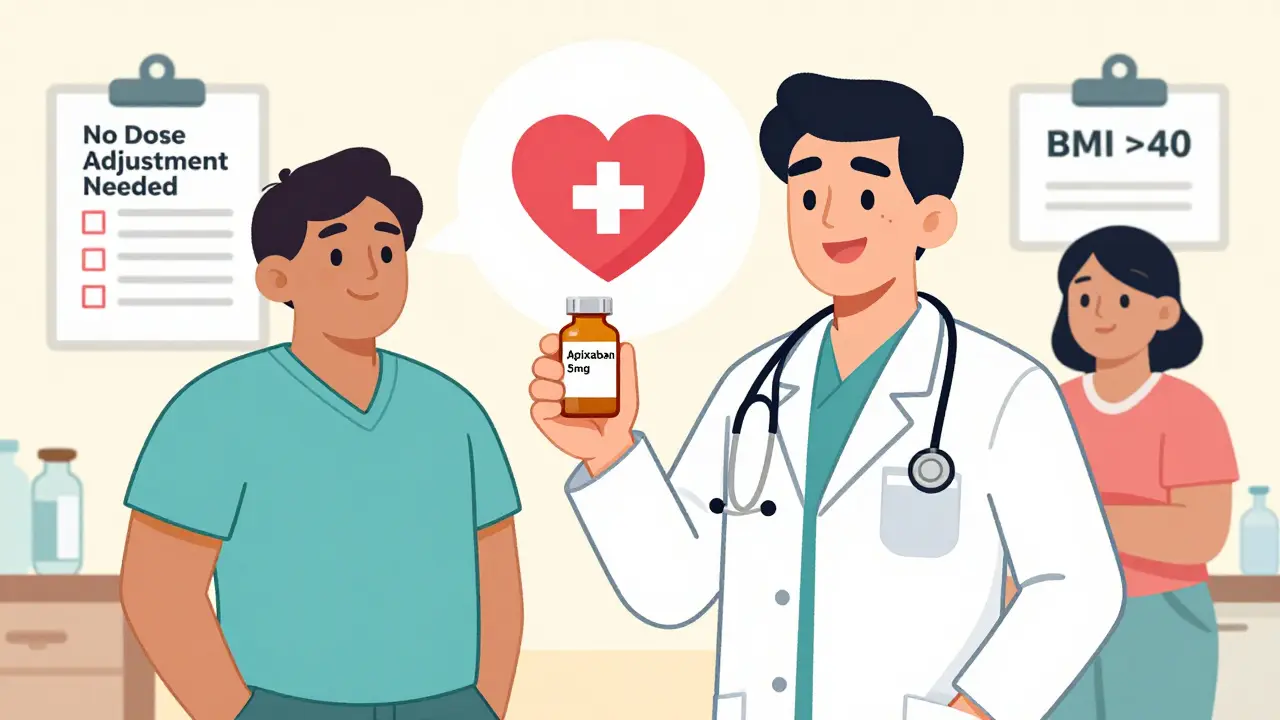
The data is clear: for most obese patients, standard doses of apixaban and rivaroxaban work just as well as they do in people of normal weight. A 2020 analysis of over 15,000 patients with atrial fibrillation found no difference in stroke risk or major bleeding between those with BMI under 30 and those over 40. That’s not a fluke. Multiple studies since then have confirmed it. For atrial fibrillation, apixaban is given as 5 mg twice daily - unless the patient is over 80, weighs under 60 kg, or has kidney issues, then it drops to 2.5 mg twice daily. That’s it. No adjustment for weight. Rivaroxaban is 20 mg once daily for AF, or 15 mg if kidney function is low. Again - no change for obesity. In treating blood clots (VTE), apixaban starts at 10 mg twice daily for seven days, then drops to 5 mg twice daily. Rivaroxaban starts at 15 mg twice daily for 21 days, then 20 mg once daily. Still no weight-based tweaks needed. The International Society on Thrombosis and Haemostasis (ISTH) says this outright: standard dosing is safe and effective for apixaban and rivaroxaban in patients with BMI over 40 or weight over 120 kg. The European Heart Rhythm Association agrees. Real-world registries show annual major bleeding rates around 2.1% for apixaban and 2.4% for rivaroxaban in obese patients - right in line with non-obese populations.Dabigatran: The One to Avoid in Morbid Obesity
Dabigatran is the exception. It works differently - it doesn’t target factor Xa like the others. It blocks thrombin directly. And in obese patients, that difference matters. Studies show a 37% higher risk of gastrointestinal bleeding in people with BMI over 40 compared to those with normal weight. One study found a 2.3-fold increase in GI bleeding risk for dabigatran users with BMI >40. That’s not a small uptick. That’s a red flag. Why? We’re not entirely sure. Maybe it’s because dabigatran is excreted partly through the gut, or maybe the drug concentrates differently in fat tissue. Either way, the data is consistent. The ISTH, EHRA, and Anticoagulation Forum all warn against using dabigatran in morbid obesity unless there’s no other option. If someone’s already on it and has a history of stomach issues, switching to apixaban or rivaroxaban isn’t just a good idea - it’s the standard of care.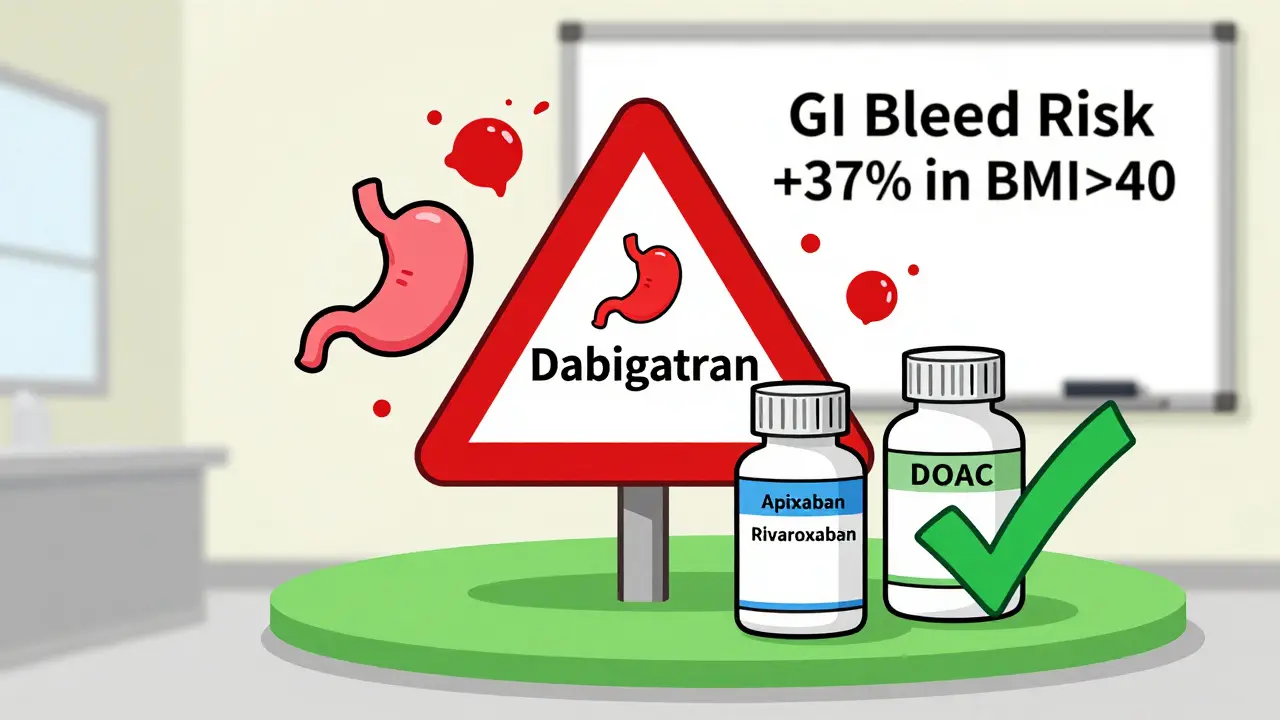
Edoxaban: Mostly Fine, But Watch the Extreme Cases
Edoxaban behaves more like apixaban and rivaroxaban. Most studies show its blood levels stay stable across BMI ranges from normal to morbidly obese. Standard dosing - 60 mg once daily for AF, or 30 mg for those with low kidney function or low weight - works fine for most. But here’s the catch: in patients with BMI over 50 or weight over 160 kg, things get fuzzy. A small study from Massachusetts General Hospital found that 18.2% of patients with BMI over 50 had subtherapeutic anti-Xa levels on standard-dose edoxaban. That means the drug wasn’t reaching the level needed to prevent clots. It’s rare - but it happens. For these extreme cases, experts recommend caution. Consider therapeutic drug monitoring if possible, or switch to apixaban or rivaroxaban. Don’t just increase the dose. There’s no evidence that higher doses of edoxaban are safer or better.What About Dose Escalation?
Some doctors, seeing a patient weighing 180 kg, think: "They need more drug." But that’s a trap. Studies have looked at doubling DOAC doses in obese patients. The results? No better protection against clots. And bleeding risk went up. The ISTH says it plainly: there is no evidence to support higher than standard dosing of DOACs in obese patients. More isn’t better. In fact, it’s riskier. Stick to the label. If the standard dose works for someone who weighs 70 kg, it works for someone who weighs 150 kg - as long as it’s apixaban or rivaroxaban.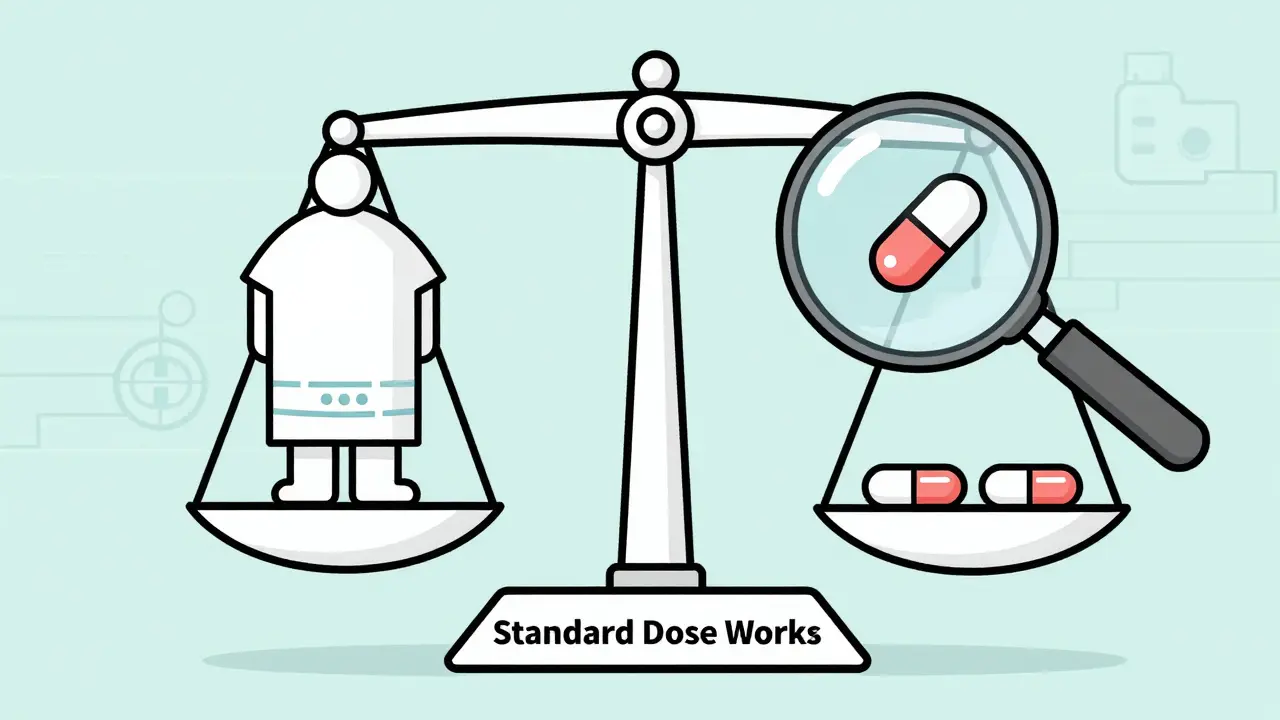
What’s Next? Research Still in Progress
We still don’t know everything. There are almost no studies on patients with BMI over 50 or weight over 160 kg. That’s a gap. The DOAC-Obesity trial (NCT04588071) is now recruiting 500 patients with BMI ≥40 to answer these questions. Results are expected in late 2024. Until then, we work with what we have. Point-of-care tests to measure DOAC levels in real time are being developed - especially for extreme obesity. Right now, they’re not routine. But if a patient on edoxaban has a clot despite standard dosing, checking the drug level might be the next step.Practical Takeaways for Clinicians
- Apixaban: Use standard dose (5 mg twice daily for AF, 10/5 mg for VTE) in all obese patients. No adjustments needed.
- Rivaroxaban: Same as apixaban. Standard dose works. No need to increase.
- Dabigatran: Avoid in BMI ≥40. High GI bleeding risk. Switch if possible.
- Edoxaban: Standard dose is fine for BMI up to 50. Consider monitoring or switching if BMI >50 or weight >160 kg.
- Never escalate dose beyond guidelines. Higher doses don’t improve outcomes and increase bleeding.
- Warfarin is not better. DOACs are safer, simpler, and just as effective in obesity.
Why This Matters for Patients
If you’re obese and on a blood thinner, you deserve treatment that’s both effective and safe. You shouldn’t have to live with daily injections, frequent blood tests, or the fear that your medication isn’t working. The science now says: you can take a pill, just like everyone else. Apixaban and rivaroxaban are your best bets. Dabigatran? Not for you. And don’t let anyone tell you to take more than the label says - it’s not safer. It’s riskier. The bottom line? Obesity doesn’t make you a special case for DOACs - unless you’re in the extreme upper range. For most, the standard dose is the right dose. And that’s good news.Can I take apixaban if I weigh over 120 kg?
Yes. Standard dosing of apixaban (5 mg twice daily for atrial fibrillation, or 10 mg twice daily followed by 5 mg twice daily for blood clots) is safe and effective even for people weighing more than 120 kg or with BMI over 40. Multiple studies and major guidelines confirm this.
Is dabigatran safe for obese patients?
No, not in morbid obesity. Dabigatran increases the risk of gastrointestinal bleeding by about 37% in patients with BMI over 40 compared to non-obese patients. Major guidelines recommend avoiding it in this group. Switch to apixaban or rivaroxaban instead.
Should I increase my DOAC dose if I’m very overweight?
No. There is no evidence that higher-than-standard doses improve outcomes in obese patients. In fact, increasing the dose may raise bleeding risk without adding protection. Stick to the approved dosing - it’s designed to work regardless of weight.
What about edoxaban in patients with BMI over 50?
Standard dosing (60 mg once daily) works for most, but in patients with BMI over 50 or weight over 160 kg, some studies show subtherapeutic drug levels in up to 18% of cases. Consider therapeutic drug monitoring or switching to apixaban or rivaroxaban if there’s concern about effectiveness.
Are DOACs better than warfarin for obese patients?
Yes. DOACs are safer, more predictable, and easier to manage than warfarin in obese patients. Warfarin requires frequent blood tests and dietary restrictions. DOACs don’t. Studies show similar or lower rates of stroke and bleeding with DOACs, even in those with BMI over 40.
What if I’m on DOAC and have a blood clot?
Don’t assume it’s because of your weight. Most clots in obese patients on DOACs happen due to non-adherence, drug interactions, or undiagnosed cancer - not inadequate dosing. Check for these causes first. Only consider drug level testing if standard dosing was used and other causes are ruled out.




December 27, 2025 AT 16:46
Just had a patient on apixaban weighing 180 kg - no issues at all. Been using it for 2 years now. No bleeding, no clots. Docs still act like it’s risky, but the data’s clear. Standard dose works. Why are we still overthinking this?