
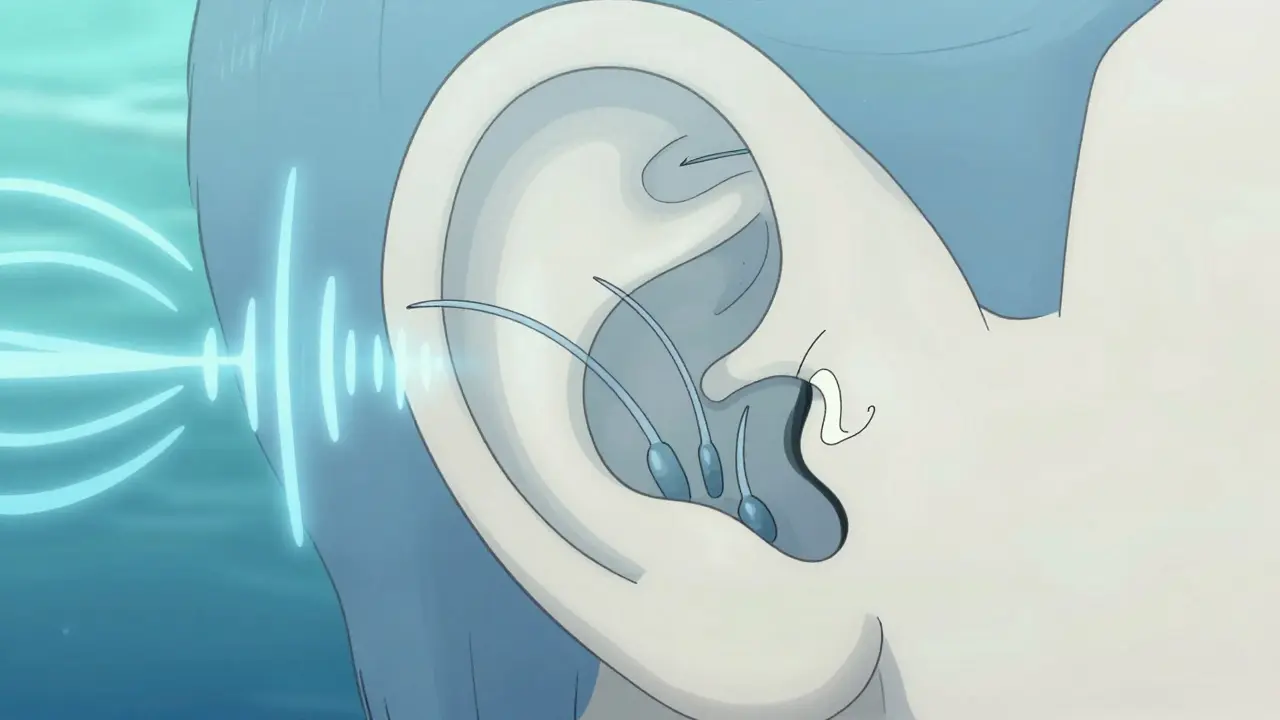
When you can’t hear your grandkid laughing or struggle to follow conversations in a crowded room, it’s not just frustrating-it’s a sign something deeper is wrong. For millions of people, this isn’t normal aging. It’s sensorineural hearing loss, a permanent type of hearing damage rooted in the inner ear. Unlike a clogged ear canal or ear infection, this isn’t something you can clear up with a visit to the doctor or a few drops. Once the tiny hair cells in your cochlea are damaged, they don’t grow back. And that’s why this condition is often called permanent deafness.
What Exactly Is Sensorineural Hearing Loss?
Sensorineural hearing loss (SNHL) happens when the inner ear’s hair cells or the auditory nerve that sends signals to your brain get damaged. These hair cells, called stereocilia, are microscopic structures inside the cochlea-a spiral-shaped, fluid-filled chamber in your inner ear. They act like tiny antennas, turning sound vibrations into electrical signals your brain can understand. When they’re bent, broken, or killed off by noise, aging, or disease, they don’t regenerate. That’s the core problem: no repair, no recovery. This is different from conductive hearing loss, where sound can’t reach the inner ear because of wax buildup, fluid, or a perforated eardrum. Those issues can often be fixed. SNHL? Not so much. About 90% of hearing loss cases that require hearing aids are sensorineural. That makes it the most common type of permanent hearing impairment.How Does Damage Happen?
There are several ways these delicate hair cells get destroyed. The biggest culprit? Noise. Exposure to sounds above 85 decibels-like heavy traffic, lawnmowers, or concerts-can slowly wear them down. Eight hours at that level is enough to start causing permanent damage. Louder sounds, like a gunshot or fireworks, can kill them instantly. Aging is another major factor. By age 65, about 25% of Americans have noticeable SNHL. By 75, that jumps to 50%. This is called presbycusis. It usually hits high-pitched sounds first-like birds chirping, children’s voices, or the letters “s” and “th” in speech. That’s why you might hear someone talking but can’t make out what they’re saying. Other causes include:- Genetics-some people inherit a predisposition to hearing loss
- Medications-certain antibiotics, chemotherapy drugs, and high-dose aspirin can be ototoxic (toxic to the ear)
- Infections-mumps, measles, meningitis, or even untreated syphilis
- Head trauma or skull fractures
- Tumors on the auditory nerve, like acoustic neuromas
- Autoimmune disorders that attack inner ear tissue
What Are the Signs You Might Have It?
The symptoms don’t always show up all at once. They creep in. You might not even notice until it’s advanced. Common signs include:- Difficulty understanding speech, especially in noisy places like restaurants or family gatherings
- Feeling like people are mumbling-even when they’re speaking clearly
- Needing to turn up the TV or radio louder than others find comfortable
- Tinnitus-a constant ringing, buzzing, or hissing in the ears (affects about 80% of SNHL patients)
- Recruitment-sounds that are soft are hard to hear, but loud sounds suddenly feel painfully loud
- Dizziness or balance issues, if the damage affects the vestibular system too
How Is It Diagnosed?
An audiologist doesn’t just ask you to say “yes” or “no” into a microphone. They use a detailed hearing test called an audiogram. This measures how well you hear different pitches at different volumes. In SNHL, the results show a consistent drop in hearing across both air conduction (sound through the ear canal) and bone conduction (sound through the skull). If there’s no gap between the two, it’s sensorineural. If there’s a gap, it’s conductive. They’ll also check your speech recognition score. People with SNHL often score low here-even if they can hear the sounds, their brain struggles to make sense of them. That’s because the nerve signals are distorted or incomplete.
Can It Be Cured?
The short answer: almost never. Once hair cells are gone, they’re gone. There’s no pill, no supplement, no ear drop that brings them back. That’s why doctors emphasize prevention-wearing ear protection, keeping volume down, and getting regular hearing checks as you age. There’s one exception: sudden sensorineural hearing loss (SSHL). This is when hearing drops dramatically over hours or days, often in just one ear. It’s rare-only 5 to 20 cases per 100,000 people-but if caught within 48 to 72 hours, steroid treatment (oral or injected) can restore hearing in 32% to 65% of cases. Delay treatment beyond two weeks, and the chances drop sharply. That’s why anyone who loses hearing suddenly needs to see a specialist immediately.What Are the Treatment Options?
Since you can’t fix the damage, the goal becomes compensation. Here’s what works:Hearing Aids
For most people with mild to moderate SNHL, hearing aids are the go-to solution. Modern digital aids don’t just make everything louder-they’re programmed to boost only the frequencies you’ve lost. If you can’t hear high pitches, they amplify those. If background noise is the problem, they use directional microphones and AI to focus on speech. Brands like Phonak, Widex, and Oticon offer models with features like Bluetooth streaming, noise reduction, and even tinnitus masking. User reviews show 78% of people report better speech clarity. But here’s the catch: they don’t restore normal hearing. In noisy rooms, they only improve understanding by 30% to 50%. Many users still struggle at family dinners or crowded meetings. Cost is another barrier. A good pair runs $2,500 to $7,000. Insurance rarely covers it. That’s why many turn to over-the-counter (OTC) hearing aids, now available without a prescription since 2022. Brands like Eargo and Lively offer cheaper options ($500-$1,500), but they’re best for mild cases.Cochlear Implants
If hearing aids aren’t enough-usually when pure-tone averages exceed 90 dB-cochlear implants become the next step. These aren’t hearing aids. They’re electronic devices surgically implanted behind the ear. A microphone picks up sound, a processor turns it into electrical signals, and an electrode array stimulates the auditory nerve directly. About 82% of recipients achieve open-set speech recognition-meaning they can understand conversations without lip-reading. But it’s not magic. It takes months of therapy to retrain your brain to interpret these new signals. Some users say everyday sounds feel painfully loud at first. The adjustment period can be tough.What About Emerging Treatments?
Scientists are working on ways to actually fix the damage-not just mask it. Stanford Medicine and other research centers are testing stem cell therapies to regenerate hair cells in animal models. Early results are promising, but human trials are still years away. One expert estimates clinical applications are 5 to 10 years off. Other innovations include AI-powered hearing aids that adapt in real time to environments, and apps that turn smartphones into prescription hearing devices. The FDA approved the first such app in 2019, and the market for OTC devices is expected to hit $2.8 billion by 2025.
Living With Permanent Hearing Loss
It’s not just about devices. It’s about adapting. People with SNHL often learn to read lips, use captioning, or sit in quieter spots during conversations. Support groups like the Hearing Loss Association of America offer workshops, local chapters, and online forums where people share tips on managing tinnitus, dealing with frustration, and finding affordable gear. The emotional toll is real. Many users report feeling isolated, embarrassed, or even depressed. One Reddit user wrote: “My hearing aids reduced my tinnitus from an 8 to a 4-but I still feel like I’m missing half the conversation.”Why This Matters
Hearing loss isn’t just a personal issue-it’s a public health crisis. The World Health Organization estimates 430 million people worldwide need rehabilitation for disabling hearing loss. In the U.S., 30 million adults have SNHL. By 2050, that number could rise by 50% due to aging populations and increased noise exposure. The economic cost? $513 billion annually in lost productivity, healthcare, and social services. Yet only 16% to 20% of adults who need hearing aids actually use them. Cost, stigma, and lack of awareness keep people silent.What Should You Do Now?
If you’re worried about your hearing:- Get a baseline hearing test-even if you think it’s fine. Do it by age 50.
- Protect your ears. Use earplugs at concerts, turn down headphones, and avoid prolonged noise exposure.
- If you lose hearing suddenly, see an ENT specialist within 72 hours.
- If you have permanent SNHL, explore hearing aids or cochlear implants with an audiologist. Don’t wait.
- Use support resources. HLAA, ASHA, and online communities offer free guides and peer support.
Can sensorineural hearing loss be reversed?
In most cases, no. The hair cells in the inner ear that cause sensorineural hearing loss don’t regenerate. Once they’re damaged, the hearing loss is permanent. The only exception is sudden sensorineural hearing loss (SSHL), which can sometimes be reversed if treated with steroids within 48 to 72 hours of onset. For all other cases, the focus is on compensation-not cure-through hearing aids, cochlear implants, or assistive devices.
Are hearing aids effective for sensorineural hearing loss?
Yes, hearing aids are the most common and effective treatment for mild to moderate sensorineural hearing loss. Modern digital hearing aids are programmed to amplify only the frequencies you’ve lost, improving speech clarity significantly. However, they don’t restore normal hearing. In noisy environments, they typically improve speech understanding by only 30% to 50%. Many users still struggle with background noise, but consistent use and proper fitting can greatly improve daily communication.
What’s the difference between sensorineural and conductive hearing loss?
Sensorineural hearing loss comes from damage to the inner ear’s hair cells or the auditory nerve. It’s usually permanent. Conductive hearing loss is caused by blockages or problems in the outer or middle ear-like earwax, fluid, or a perforated eardrum. This type can often be treated medically or surgically, and hearing may return fully. Audiologists can tell the difference using an audiogram that compares air and bone conduction thresholds.
How do I know if I need a cochlear implant?
Cochlear implants are typically recommended when hearing aids no longer provide enough benefit. This usually means your pure-tone average (a measure of hearing loss across key frequencies) is above 90 dB HL. You’ll also have poor speech recognition-even with the best hearing aids. A team of audiologists and ENT specialists will evaluate your hearing, medical history, and expectations before recommending implantation. Success rates are high: 82% of users achieve open-set speech recognition after rehabilitation.
Can noise exposure cause permanent hearing loss?
Yes, noise is the leading preventable cause of sensorineural hearing loss. Exposure to sounds above 85 decibels for prolonged periods-like factory noise, power tools, or loud music-can permanently damage inner ear hair cells. A single exposure to a very loud sound, like an explosion, can cause immediate and irreversible damage. The damage builds up over time, which is why many people don’t notice until their 50s or 60s. Using ear protection and limiting exposure can prevent most noise-induced hearing loss.
Is sensorineural hearing loss hereditary?
Yes, genetics can play a role. Some people inherit gene mutations that make their inner ear more vulnerable to damage from aging or noise. Conditions like Usher syndrome or Pendred syndrome are inherited and cause sensorineural hearing loss from birth or early childhood. Even without a known syndrome, family history of early hearing loss increases your risk. If your parents or grandparents lost hearing young, it’s wise to get regular hearing checks starting in your 30s or 40s.




January 1, 2026 AT 19:42
Just got my first hearing aids last month. Still get frustrated when the dog barks and it sounds like a jet engine but my grandkids' voices? Clear as day now. Best $1200 I ever spent.