Ever wonder why some generic drugs hit the pharmacy shelves almost immediately after a patent expires, while others take years? It usually isn't about the science of making the pill-it's about the cost and chaos of the regulatory finish line. For a pharmaceutical company, getting a FDA approval costs isn't just a one-time fee; it's a strategic gamble involving millions of dollars and a mountain of paperwork. If they get a single detail wrong in their application, they don't just lose time-they lose millions in potential revenue while patients continue to pay brand-name prices.
| Cost Factor | Generic (ANDA) | Brand-Name (NDA) |
|---|---|---|
| Application Fee | ~$375,000 (Total estimated) | $3.685 Million |
| Submission Volume | 150k - 200k pages | Significantly Higher |
| Review Target | 8-10 Months | Variable by Priority |
The Money Behind the Medicine: How GDUFA Works
To understand the costs, you have to understand GDUFA is the Generic Drug User Fee Amendments, a program that allows the FDA to collect fees from generic drug manufacturers to fund the review process. Before this started in 2012, the FDA was drowning in a backlog of applications. The logic was simple: if the industry pays, the FDA can hire more reviewers, and drugs get to market faster.
Under the current GDUFA III framework, the costs are split into different buckets. For the 2025 fiscal year, companies face a facility fee of $238,055 per site and a product fee of $136,485 per application. While that might sound like a drop in the bucket for a giant corporation, the cumulative cost of maintaining multiple facilities and filing dozens of applications adds up. Small businesses with fewer than 1,000 employees can get waivers, but for mid-sized firms, these fees are just the entry ticket.
The ANDA Process: More Than Just a Fee
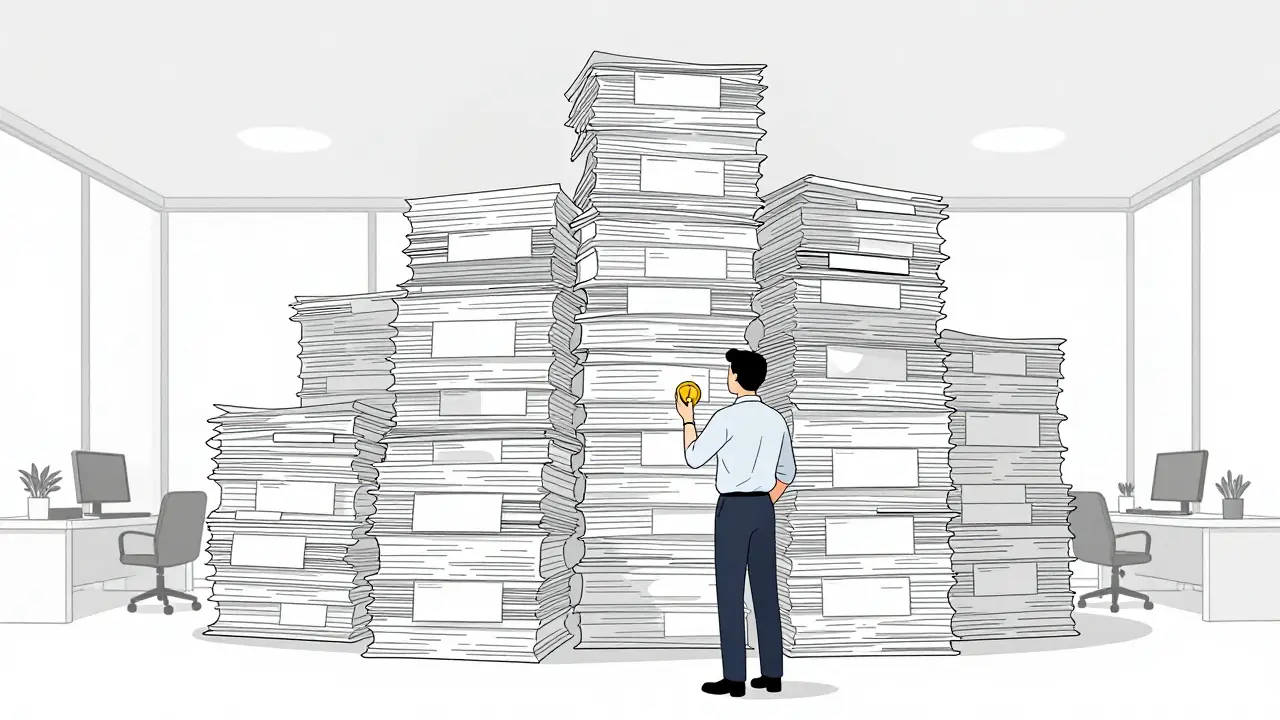
When a company wants to launch a generic, they file an ANDA is an Abbreviated New Drug Application, which requires the manufacturer to prove the generic version is bioequivalent to the brand-name original. Unlike brand-name drugs, they don't have to redo all the clinical trials, which is why the costs are lower. However, the paperwork has exploded. Submissions that used to be 50,000 pages are now hitting 200,000 pages.
The real financial danger isn't the initial fee-it's the Complete Response Letter (CRL). If the FDA sends back a CRL, it means the application wasn't approved in the first cycle. Fixing the issues cited in a CRL can cost a company between $2 million and $5 million and push the launch back by nearly a year. For a drug that might generate hundreds of millions in sales, a 12-month delay is a financial catastrophe.
The Complex Generic Trap
Standard pills are easy. But "complex generics"-think nasal sprays, inhalers, or long-acting injectables-are a different story. In 2015, the FDA changed how it gives feedback on these products. Instead of telling manufacturers exactly why a formula failed the "sameness" test, the agency started giving vague responses.
This created a trial-and-error nightmare. Imagine spending $8.7 million on three different reformulation attempts for a single nasal spray because the regulator won't tell you exactly what's wrong with the mixture. This lack of transparency has increased development costs by up to 40% for complex products. It’s a bureaucratic hurdle that keeps cheaper versions of critical medicines out of patients' hands for years.
Economic Impact: Who Actually Pays?
The ripple effect of these regulatory costs is felt most by the people at the pharmacy counter. When approval is delayed, brand-name companies maintain their monopoly. For example, between 2016 and 2020, generic versions of testosterone replacement therapies were delayed by nearly five years, forcing patients to pay 300% more than they would have if the generic had been approved.
On the flip side, generics are the backbone of healthcare savings. In 2024, they generated roughly $467 billion in savings. To put that in perspective, generics handle about 90% of all prescriptions filled in the U.S. but only account for 12% of total drug spending. The tension here is clear: while the FDA needs fees to ensure safety, excessive bureaucratic friction acts as a hidden tax on the healthcare system.
Looking Ahead: H.R. 1843 and the Future
There is a push to fix the complex generic bottleneck. A piece of legislation called H.R. 1843, also known as the Increasing Transparency in Generic Drug Applications Act, aims to force the FDA to bring back detailed formulation feedback. If this passes, the Congressional Budget Office estimates it could shave 18 to 24 months off the approval timeline for complex drugs.
As we move toward GDUFA IV (the 2028-2032 cycle), the industry is debating whether to increase fees by another 3-5% annually. The goal is to hit a 90% first-cycle approval rate for priority applications. The challenge is balancing speed with safety. Some pharmacists argue that the current rigor prevents disasters like the 2022 valsartan recall, which affected 22 million people. Speed is great, but not if it means compromising the quality of the medicine.
What is the average cost of an ANDA application fee?
For FY 2025, the direct costs include a product fee of $136,485 and a facility fee of $238,055. Combined with other administrative costs, the total entry cost per application is roughly $375,000, though this does not include the millions spent on research, development, and reformulation.
Why are complex generics more expensive to get approved?
Since a 2015 policy change, the FDA provides less specific feedback on formulation discrepancies for complex generics. This forces companies into a costly cycle of reformulation and re-testing, often adding 2-3 years to the development timeline and increasing costs by 25-40%.
What is a CRL and why does it matter?
A Complete Response Letter (CRL) is a notification from the FDA that an application cannot be approved in its current form. Addressing a CRL typically costs between $2 million and $5 million per application and adds 8-12 months of delay, which can significantly impact a company's return on investment.
Do small businesses have to pay the full GDUFA fees?
No, the FDA provides small business waivers for companies with fewer than 1,000 employees to ensure that smaller players can still compete in the generic drug market.
How much do generics save the US healthcare system?
According to the 2025 Savings Report, generics and biosimilars generated $467 billion in healthcare savings in 2024 alone. Medicare Part D beneficiaries specifically saved an average of $1,152 per enrollee due to the use of generic drugs.