
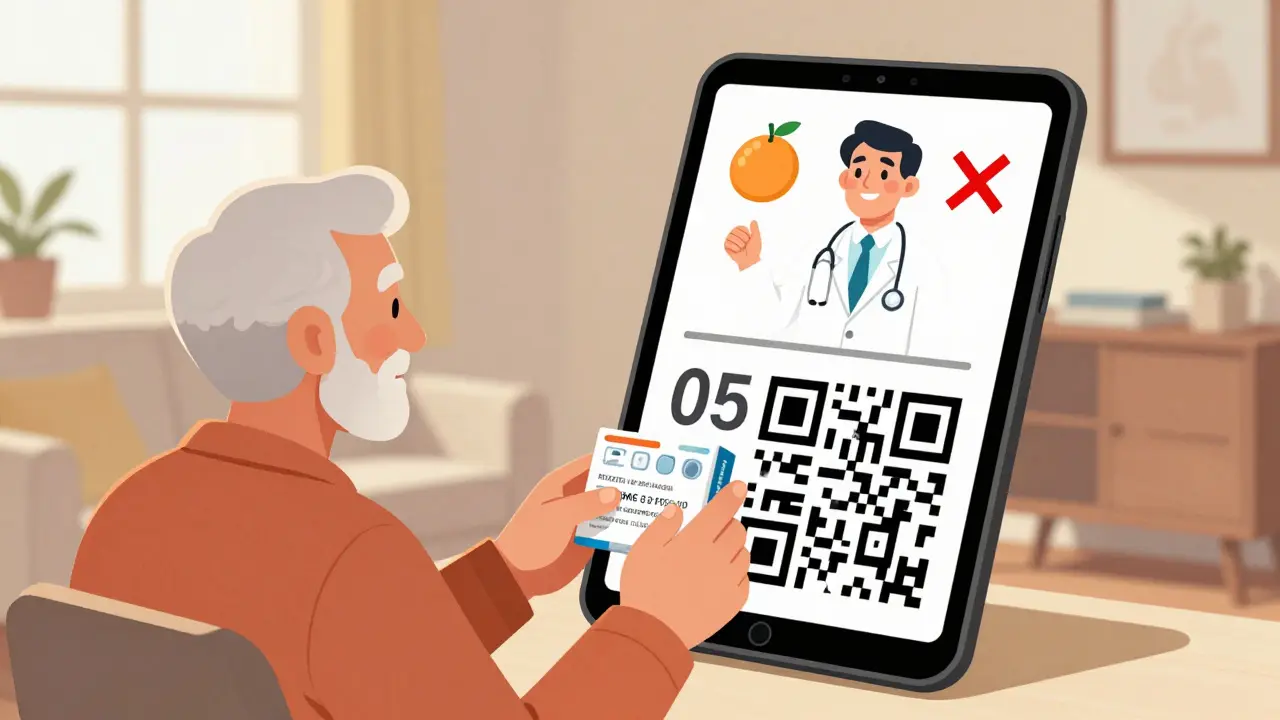
Imagine you’re handed a new prescription. You read the tiny print on the paper insert, but half the words are blurry. Later that night, you get a text from your pharmacist: "Your medication has a new warning. Scan the QR code on the box." You scan it. In seconds, you’re watching a 90-second video from your doctor explaining exactly what to watch for - no jargon, no tiny font, no waiting months for a printed update.
This isn’t science fiction. It’s happening now. Since 2021, countries like Spain and the UK have quietly rolled out QR codes on drug labels that link directly to live safety updates. No more waiting for revised leaflets to hit pharmacy shelves. No more outdated warnings sitting in medicine cabinets. Just instant, accurate, real-time information - right when you need it.
Why Static Labels Are Out of Date
For decades, drug labels were printed once and stuck on boxes forever. If a new safety alert popped up - say, a dangerous interaction with a common food or a sudden risk of liver damage - manufacturers had to reprint entire batches. That process took months. In the meantime, patients kept taking pills with outdated info.
According to industry data, around 225 black box warnings - the strongest safety alerts the FDA and global regulators issue - are issued each year. That’s one every 1.6 days. And each one means hundreds of thousands of bottles with old labels floating out there. One study found that nearly 30% of patients on long-term meds were unaware of critical safety changes because they never received updated paper inserts.
QR codes fix this. They turn the label from a static piece of paper into a live portal. When a new warning is approved, the content behind the QR code updates instantly. No new printing. No new shipping. No delay. Patients get the truth the moment it’s verified.
How It Actually Works
It’s not just a link to a webpage. The system is built like a secure, living database.
- Each QR code is dynamic - meaning the content it points to can be changed remotely. A static QR code would break if the info changed. A dynamic one updates silently.
- The code links to a secure, encrypted server hosted by the drugmaker - not a random website. This stops counterfeiters from swapping out links.
- When you scan it, your phone checks the lot number and expiration date on the label. If they match what’s in the manufacturer’s system, you get the official info. If not, you’re warned: "This product may not be authentic."
- Behind the scenes, the system logs every scan. Not who you are - just that a scan happened, when, and from what country. This helps regulators track how widely updates are being accessed.
Companies like DosePacker and sQR.me have built platforms that connect these QR codes directly to pharmacovigilance databases. If a new side effect is reported in Brazil, it can be pushed to the QR code content within hours - not months. The system even supports multilingual updates. A patient in Sydney scans the code and gets English. A patient in Toronto gets French. The same code, different language, same accuracy.
Real Impact: What’s Changing
It’s not just about convenience. It’s about saving lives.
At a hospital in Manchester, staff started using QR-coded discharge meds in early 2024. Within six months, they saw a 40% drop in patients calling back confused about their dosing schedule. One elderly man, on a new blood thinner, scanned the code and saw a short video: "Avoid grapefruit. It can cause bleeding." He’d never heard that before. His doctor said he’d have missed it on the paper insert.
Pharmacists report similar wins. In a 2024 survey, 85% said they preferred using QR-linked electronic patient information leaflets (ePILs) to explain meds to patients. Why? Because they could show a video, highlight a warning in color, or even link to a printable checklist. It’s not just text anymore - it’s tailored, visual, and interactive.
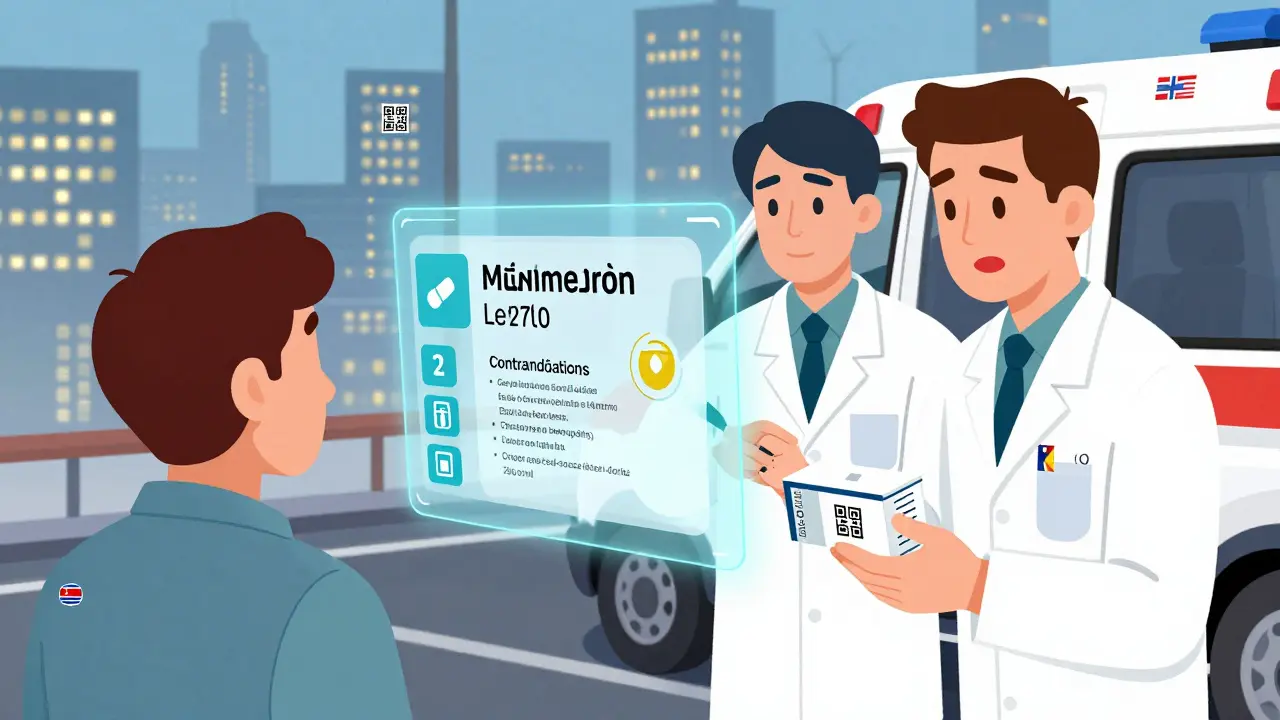
Emergency responders are also benefiting. Freyr Solutions documented a case where paramedics responded to a cardiac arrest. The patient had a QR code on their heart medication. Scanning it instantly pulled up the full drug profile, including contraindications and recent warnings. That saved critical minutes.
The Flip Side: Who Gets Left Behind
It’s not perfect.
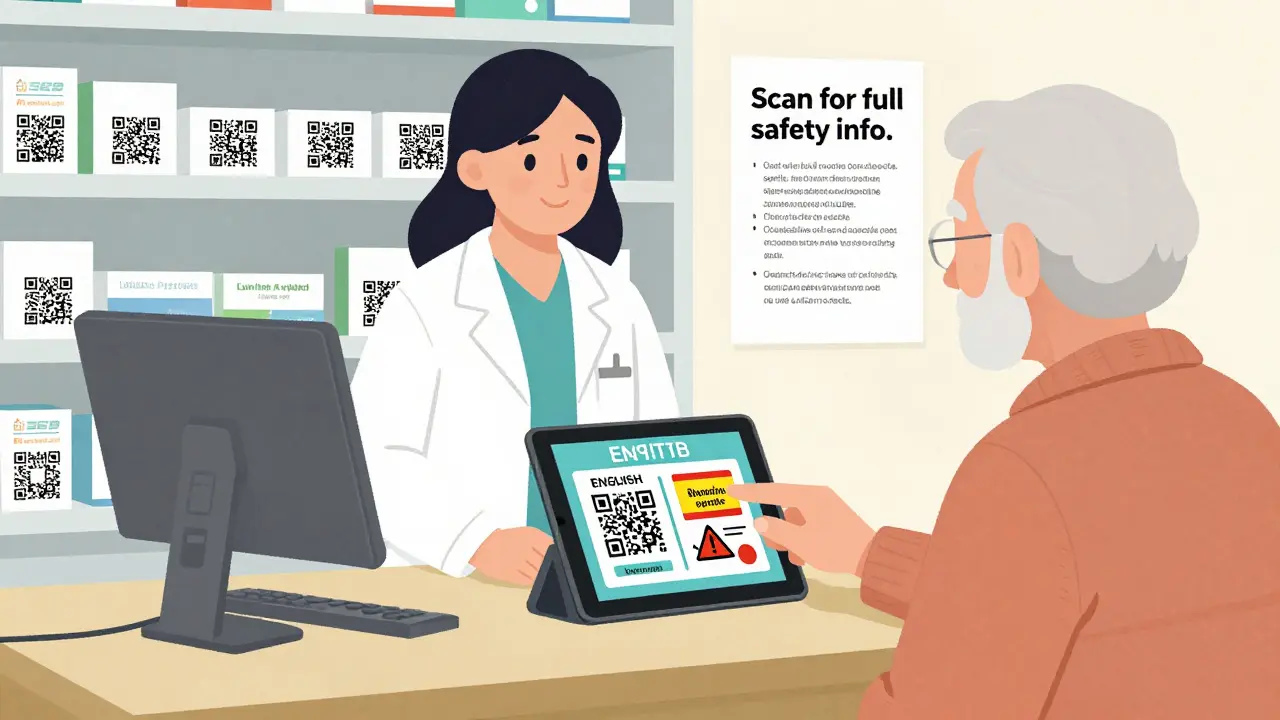
Not everyone has a smartphone. Not everyone can use one. In rural areas and among older adults, tech barriers are real. One study found that 60% of elderly patients in three rural clinics couldn’t scan the QR code - not because they didn’t want to, but because their phone was too old, their screen too dim, or they’d never learned how.
That’s why smart implementations don’t replace paper. They add to it. Leading programs now include a small printed summary on the label - "Scan for full safety info" - with key warnings still printed in large type. Pharmacies offer free scanning stations. Community centers run QR tutorials. It’s not about forcing people to go digital - it’s about making digital an option that works for everyone.
There’s also the privacy question. Are scan logs being sold? Are personal details tracked? The answer is no - not in compliant systems. The logs only record: "A scan occurred at 2:14 p.m. in Germany." No name. No location. No device ID. Just enough to know the update reached people.
Global Adoption: Who’s Ahead
Europe is leading. Spain was first in 2021. The UK followed in 2024 with its updated ABPI Code, making QR codes legal in promotional materials and patient info. Germany, France, and the Netherlands are testing pilots. The European Federation of Pharmaceutical Industries (EFPIA) is expected to issue formal guidelines by late 2026.
The U.S. is slower, but moving. Military pharmacies began using QR codes on prescriptions in 2022. The VA is testing them in 12 states. The FDA hasn’t mandated them yet - but they’re watching closely. In 2025, the FDA is expected to release draft guidance on e-labeling.
Meanwhile, in Asia and Africa, rollout is patchy. Infrastructure gaps - poor internet, low smartphone use, regulatory uncertainty - slow adoption. But companies are starting to build low-bandwidth versions: QR codes that work with SMS. Scan it, get a text link. No app needed.
What’s Next
The future isn’t just QR codes. It’s QR codes + AI + EHRs.
Imagine your QR scan not only shows safety info - but also checks your medical history. If you’re on blood pressure meds and scan a new antibiotic, the system could flag: "This drug may raise your BP. Your last reading was 150/95. Talk to your doctor." That’s already being tested in pilot programs.
Some platforms are linking QR codes directly to medication apps. Scan once, and the drug auto-adds to your pill tracker. Set reminders. Get refill alerts. Report side effects with one tap. It turns a label into a personal health assistant.
By 2030, experts predict every major drug will have a QR code. Not because it’s trendy - because it’s safer. And safer means fewer hospitalizations, fewer deaths, fewer mistakes.
What You Can Do Today
If you’re prescribed a new medication and see a QR code on the box:
- Scan it. Even if you think you know the drug.
- Watch the video or read the page. It might have new warnings you’ve never heard.
- If you can’t scan it - ask your pharmacist. They have scanners. They’ll show you.
- Don’t ignore it. That code is there because someone’s life depends on you seeing this update.
And if you’re a caregiver, a nurse, or a pharmacist - start asking: "Is this drug QR-coded?" If not, push for it. Because in a world where drug safety moves faster than paper can print, the only way to keep up is to go digital - but never leave anyone behind.
Are QR codes on drug labels safe to scan?
Yes - if the code comes from a legitimate pharmaceutical company. QR codes on approved drugs link to encrypted, manufacturer-hosted servers that verify the product’s lot number and expiration date. If the code leads to a suspicious site or asks for personal info, it’s fake. Always check the label for the official drugmaker’s name and logo. If in doubt, call your pharmacist.
Do I need an app to scan the QR code?
No. Most modern smartphones can scan QR codes with the built-in camera. Just open the camera app, point it at the code, and wait for a notification to pop up. You don’t need to download anything. If your phone doesn’t auto-detect it, try a free QR scanner app - they’re available on both iOS and Android.
What if I don’t have a smartphone?
You’re not left out. All QR-coded medications still include printed safety information - often in larger print than before. Pharmacies are required to provide printed copies upon request. Many also offer free scanning stations at the counter. Ask your pharmacist to show you the info - they’ll help you understand it.
Can the QR code track me or my location?
No. Legitimate pharmaceutical QR codes do not collect personal data. The system logs only that a scan occurred - not who scanned it, where, or from what device. The goal is to track how widely safety updates are being accessed, not to monitor patients. Privacy is built into the design, following GDPR and HIPAA standards.
Why do some drugs have QR codes and others don’t?
It depends on the manufacturer and the country. Newer drugs, especially those with complex dosing or frequent safety updates, are more likely to have them. In Europe, adoption is widespread. In the U.S., it’s still growing. Older drugs may not have been updated yet. But by 2027, most major medications will include QR codes as standard.
QR codes on drug labels aren’t a gimmick. They’re a necessary upgrade in a world where medicine moves faster than paper can keep up. The goal isn’t to replace human care - it’s to give it better tools. And for millions of people taking life-changing meds, that means one less thing to worry about.




February 23, 2026 AT 23:02
OMG this is incredible!!! 😍 I just scanned my mom’s new blood pressure med QR code and it showed a video from her cardiologist explaining why she should avoid grapefruit-she had NO idea!! 🙌 I’m crying happy tears. This is the kind of innovation that actually saves lives. Thank you to whoever designed this!!