

One bite of a contaminated salad. A handshake with someone who just used the bathroom. A shellfish dinner from a questionable vendor. These aren’t just risky choices-they’re potential triggers for hepatitis A, a virus that spreads silently through food and can shut down restaurants, schools, and entire communities.
How Hepatitis A Moves Through Food
Hepatitis A isn’t airborne. It doesn’t float through the air or spread by coughing. It travels through poop. And when that poop gets on hands, then on food, it becomes a public health emergency.The virus is tiny-so small that as few as 10 to 100 particles can infect someone. That’s less than a grain of salt. It survives freezing, drying, and even brief exposure to heat. Studies show it can live on stainless steel surfaces for up to 30 days and stay infectious in frozen food for years. That’s why outbreaks often trace back to frozen berries, raw shellfish, or pre-washed salads that were handled by someone who didn’t wash their hands properly after using the bathroom.
Food handlers are the most common link in the chain. A 2025 study in Frontiers in Public Health found that one infected worker can spread the virus to dozens, sometimes hundreds, of customers during a single shift. The problem? Many infected people don’t feel sick right away. In fact, 30% to 50% of adults, and nearly all children, show no symptoms at all. But they’re still shedding the virus in their stool-contaminating surfaces, utensils, and food-weeks before they even know they’re sick.
Shellfish are a major concern. They filter water, and if that water is polluted with sewage, the virus gets trapped inside. The FDA says shellfish from waters with more than 14 fecal coliforms per 100 milliliters are unsafe. Yet, 92% of shellfish-related outbreaks come from exactly that kind of water.
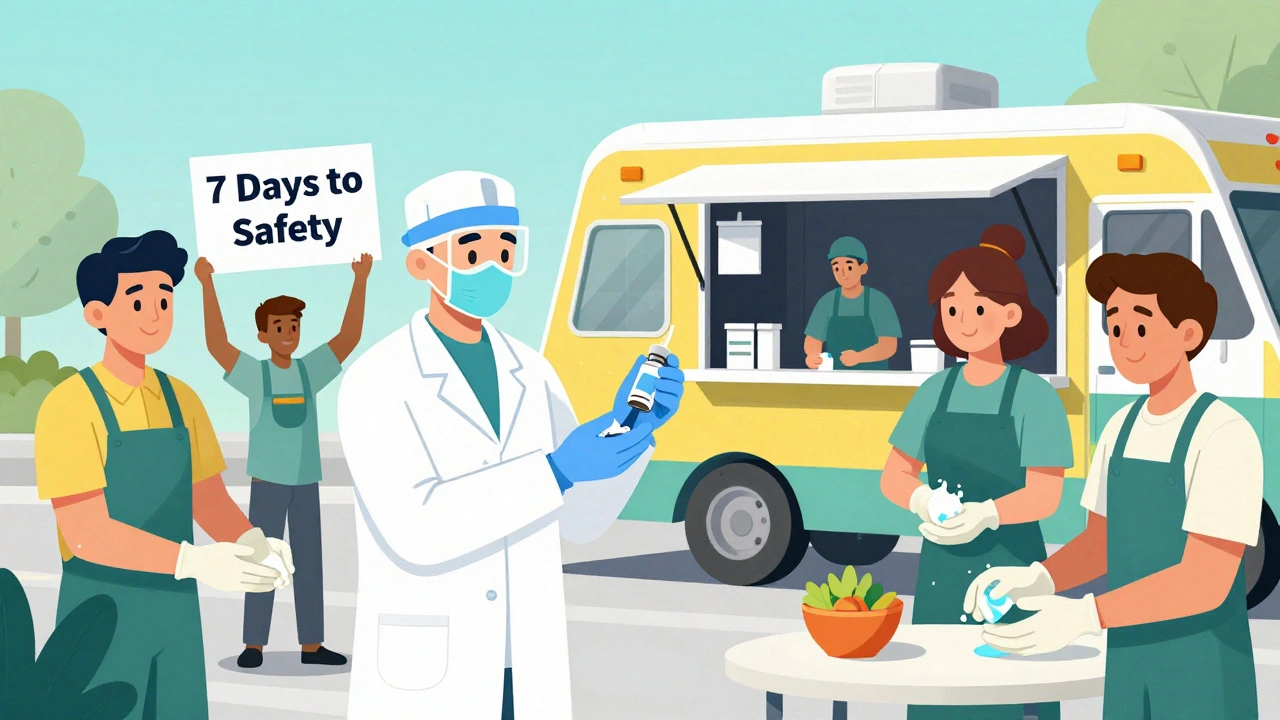
Handwashing is the first line of defense. But here’s the catch: washing with water alone cuts transmission by only 20%. Washing with soap for at least 20 seconds? That drops it by 70%. Still, only 42% of food establishments consistently use gloves or tongs for ready-to-eat food, and 78% fail to enforce bare-hand contact rules. In many kitchens, workers touch raw meat, then salad, then cash registers-all without washing up.
Who’s at Risk-and When It’s Too Late
You don’t have to travel overseas to get hepatitis A. In countries with routine childhood vaccination, like the U.S., most cases now come from foodborne outbreaks. The virus has an incubation period of 15 to 50 days, averaging 28. That means if you ate something contaminated on a Tuesday, you might not feel sick until next month.People become contagious 1 to 2 weeks before symptoms start. That’s the silent window. You could be shaking hands at work, serving food at a buffet, or hugging your kids-and spreading the virus without knowing it. Symptoms, when they appear, include fever, fatigue, nausea, dark urine, and jaundice-the yellowing of skin and eyes. But many people, especially under 6, never develop jaundice.
That’s why outbreaks often go unnoticed until multiple people get sick at once. A cluster of cases at a restaurant, school, or nursing home triggers a public health investigation. By then, it’s often too late to stop the spread.
Post-Exposure Prophylaxis: What to Do After You’ve Been Exposed
If you’ve eaten at a restaurant where a worker was later confirmed to have hepatitis A, or if you shared food or utensils with someone who just got diagnosed, time is critical. You have just 14 days after exposure to get protection.There are two options:
- Hepatitis A vaccine-a single shot for people aged 1 to 40. It gives long-term protection, often for 25 years or more. It’s the preferred choice for healthy adults and children in this age group.
- Immune globulin (IG)-an injection of antibodies that offers short-term protection (2 to 5 months). It’s used for people over 40, those with liver disease, or anyone with a weakened immune system.
The vaccine costs $50 to $75. IG costs $150 to $300. But the real cost? An outbreak investigation. The average outbreak costs between $100,000 and $500,000. That’s why getting PEP fast isn’t just about personal health-it’s about stopping a chain reaction.
Here’s the catch: PEP doesn’t work instantly. Even if you get the shot, you’re still contagious for up to 6 weeks. That means you must avoid preparing food, caring for others, or working in food service until your doctor says it’s safe. You must also wash your hands religiously-every time you use the bathroom, before touching anything food-related.

What Happens After an Infection?
If you get hepatitis A, you’ll likely recover fully. The virus doesn’t cause chronic liver disease like hepatitis B or C. But recovery can take weeks to months. Fatigue lingers. Appetite vanishes. Some people are too sick to work for a month.For food workers, returning to work isn’t just about feeling better-it’s about rules. The CDC says you can return after 7 days from the start of jaundice, or 14 days after symptoms begin. But rules vary. California requires 14 days from symptom onset. Iowa says 7 days after jaundice. If you’re a food handler, you must get clearance from your local health department before returning.
And here’s something most people don’t realize: once you’ve had hepatitis A, you’re immune for life. Your body makes antibodies that protect you forever. That’s why vaccination is so powerful-it mimics natural immunity without the illness.
Why Vaccination Isn’t Enough-And What Needs to Change
You might think, “If I got the vaccine, I’m safe.” But here’s the problem: only about 30% of food service workers in the U.S. are vaccinated. In fast-food and seasonal jobs, where turnover hits 60% a year, it’s as low as 15%.Why? Cost, confusion, and lack of enforcement. Many workers don’t know they need it. Employers don’t require it. And in many states, it’s still optional.
But that’s changing. As of January 2024, 14 U.S. states now require hepatitis A vaccination for food handlers-up from just 6 in 2020. California’s 2022 mandate prevented an estimated 120 infections and saved $1.2 million in outbreak response costs.
Some restaurants are taking matters into their own hands. A pilot program in Washington offered $50 bonuses to staff who got vaccinated. Result? Vaccination rates jumped by 38 percentage points.
Training matters too. Studies show hands-on demonstrations improve compliance by 65%. But only 31% of food service places use them. Most still rely on posters and verbal reminders.
And there’s new tech on the horizon. Researchers are testing wastewater sampling in restaurants to detect the virus before anyone gets sick. Early results show 89% accuracy. Point-of-care blood tests-fast, cheap, and accurate-are in Phase 3 trials. If they work, we could screen workers in minutes, not weeks.
What You Can Do Right Now
You don’t need to wait for an outbreak to act. Here’s what works:- If you’re a food worker: Get vaccinated. Ask your employer to cover the cost. If they won’t, pay for it yourself. One shot can save lives.
- If you’re a parent: Make sure your kids are vaccinated. Hepatitis A vaccine is part of the routine childhood schedule in the U.S. and many other countries.
- If you eat out: Wash your hands before eating. Don’t assume the staff washed theirs. If you see someone handling food with bare hands, speak up.
- If you’re exposed: Call your doctor or local health department within 14 days. Don’t wait for symptoms. PEP works only if given early.
Heating food to 85°C for 1 minute kills the virus. That’s why properly cooked shellfish is safe. But raw or lightly cooked? That’s where the risk lives.
Safe water, clean hands, and vaccination aren’t just public health slogans-they’re the only tools we have to stop this virus. And right now, they’re not being used well enough.
What’s Next for Hepatitis A Control
The CDC’s 2023-2025 plan aims to cut foodborne hepatitis A outbreaks by 50%. That’s possible-but only if we fix the gaps.Right now, 73% of outbreaks happen in places with high staff turnover: quick-service restaurants, food trucks, temporary event vendors. These are the places where workers come and go, where training is rushed, and where vaccination is ignored.
The future lies in integration: linking vaccination records to food handler permits, making testing part of routine checks, and offering real incentives-not just reminders. If we treat hepatitis A prevention like we treat food safety inspections-with regular audits, penalties for noncompliance, and rewards for best practices-we can stop these outbreaks before they start.
It’s not about fear. It’s about action. One vaccine. One handwash. One rule enforced. That’s how we end this.
Can you get hepatitis A from cooked food?
Yes, but only if the food was contaminated before cooking and wasn’t heated to at least 85°C for one minute. The virus survives temperatures up to 60°C for an hour, so undercooked food-like raw shellfish, lightly steamed vegetables, or cold salads-can still carry live virus. Proper cooking kills it, but contamination after cooking (like with dirty hands) can re-introduce it.
How long is a person contagious with hepatitis A?
A person becomes contagious 1 to 2 weeks before symptoms appear and remains infectious for about a week after jaundice starts. For people without jaundice, they can shed the virus for up to two weeks after symptoms begin. This is why asymptomatic spread is so dangerous-many people don’t know they’re contagious until it’s too late.
Is the hepatitis A vaccine safe?
Yes. The hepatitis A vaccine has been used safely for over 25 years. Common side effects are mild: soreness at the injection site, headache, or low-grade fever. Severe reactions are extremely rare. It’s safe for children, adults, pregnant women, and people with chronic liver disease. It’s also effective in over 95% of recipients after one dose.
Can you get hepatitis A more than once?
No. Once you’ve had hepatitis A or received the full vaccine series, your body develops lifelong immunity. The virus doesn’t stay in your system, and you won’t get infected again. That’s why vaccination is so effective-it gives you the same protection as having had the disease, without the illness.
Should all food workers be required to get vaccinated?
Yes, according to public health experts. With outbreaks costing up to half a million dollars each and 73% occurring in high-turnover food service settings, vaccination is the most cost-effective prevention tool. States like California and New York have already made it mandatory. Experts estimate a return of $3.20 for every $1 spent on vaccinating food workers. It’s not just about health-it’s about economic safety.
What’s the difference between hepatitis A vaccine and immune globulin?
The hepatitis A vaccine triggers your immune system to make its own long-lasting antibodies, offering protection for 25+ years. Immune globulin (IG) gives you ready-made antibodies that protect you for only 2 to 5 months. IG is used for people who can’t get the vaccine-like those over 40, with weakened immune systems, or with severe liver disease. The vaccine is preferred for healthy people under 40 because it’s cheaper and gives lasting protection.
If you’ve ever eaten at a restaurant and later heard about a hepatitis A case, you know how quickly fear spreads. But knowledge spreads faster. Get vaccinated. Wash your hands. Speak up. That’s how we stop the next outbreak before it begins.


December 11, 2025 AT 15:36
One handwash can stop a chain reaction. Seriously. That’s it. No magic. Just soap and 20 seconds. Why is this so hard?