
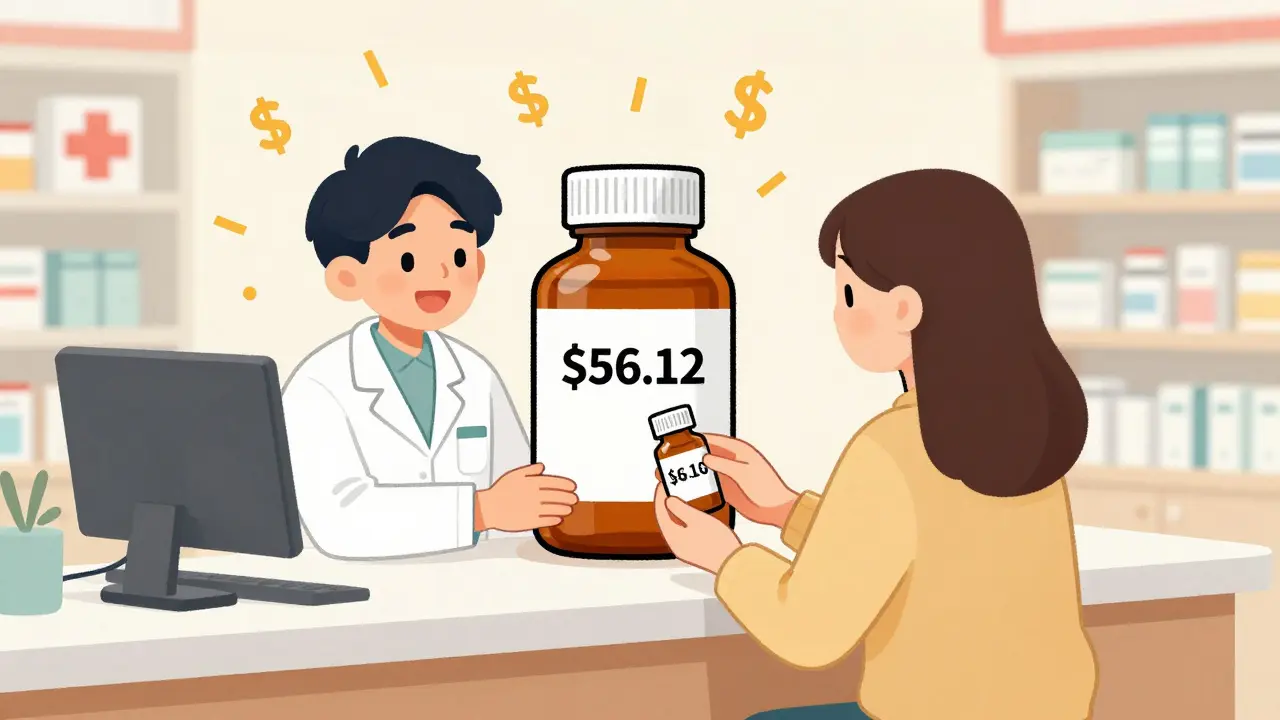
Every year, Americans spend over $600 billion on prescription drugs. But here’s the surprising part: generic medications make up 90% of all prescriptions filled, yet they cost just 1.5% of total healthcare spending. That’s not a typo. Generics are saving the U.S. healthcare system hundreds of billions annually - and most people don’t even realize how much they’re saving just by choosing the generic version of their pill.
What Exactly Are Generic Medications?
Generic drugs are exact copies of brand-name medications, approved by the FDA after the original patent expires. They contain the same active ingredients, work the same way in the body, and meet the same strict standards for strength, purity, and safety. The FDA requires generics to be bioequivalent - meaning they deliver the same amount of medicine into your bloodstream at the same rate as the brand-name version. That’s not a guess. It’s a legal requirement backed by clinical testing. You might think, “If it’s the same, why is it so much cheaper?” The answer is simple: no marketing. No expensive TV ads. No sales reps paying doctors to prescribe it. No patent monopoly. Once a brand-name drug’s patent runs out, multiple companies can make the same drug. Competition drives prices down - fast.How Much Money Are You Really Saving?
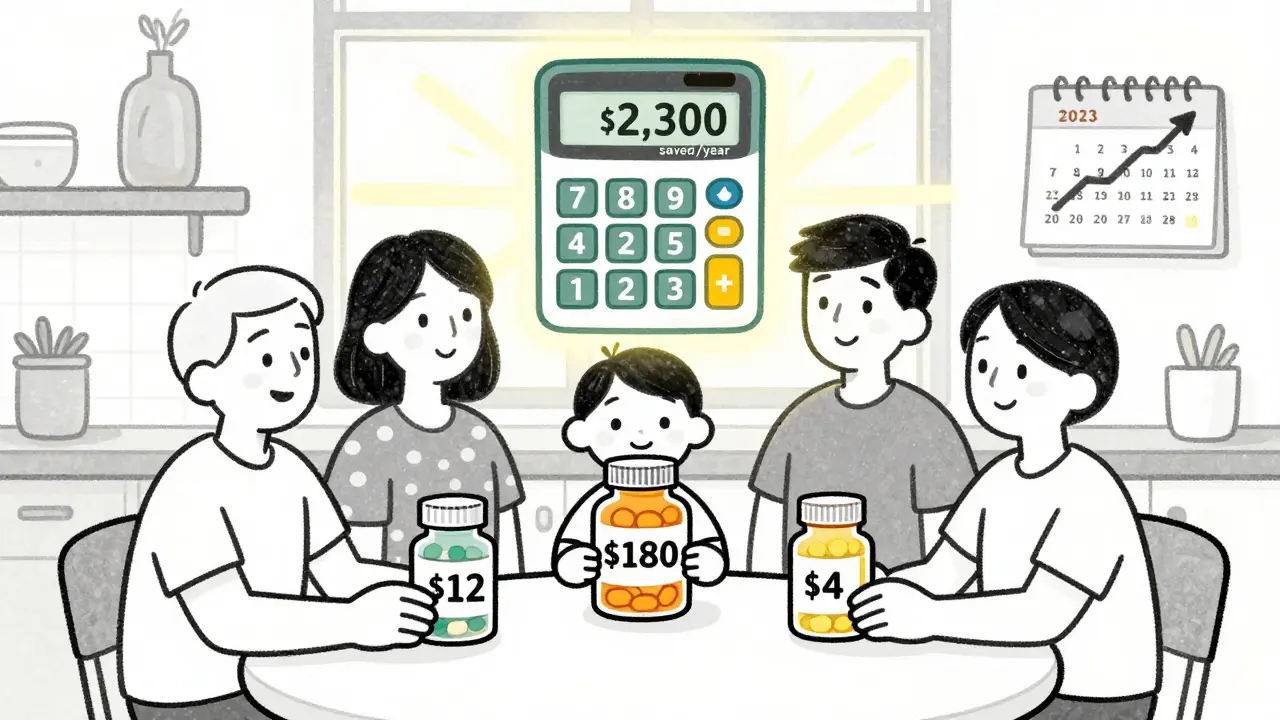
Let’s talk numbers. In 2022, generics and biosimilars saved the U.S. healthcare system $408 billion. That’s more than the entire annual budget of the state of California. Over the past decade, they’ve saved a total of $2.9 trillion. At the pharmacy counter, the difference is even more obvious. The average copay for a generic is $6.16. For a brand-name drug? $56.12. That’s over nine times more. Nine. Think about that next time you’re handed a prescription. If you’re taking a monthly medication like high blood pressure or cholesterol pills, switching to generic could save you $600 a year - just on copays alone. A 2022 study from Johns Hopkins found something even more striking: some generic drugs were 15 times more expensive than other generics for the same condition. One example: a generic version of levothyroxine (a thyroid medication) cost $180 a month, while another generic version of the same drug cost just $12. That’s a 93% savings just by choosing a different generic. It’s not about brand vs. generic - it’s about which generic you pick.Why Do Brand-Name Drugs Still Cost So Much?
Even though generics dominate the market, brand-name drugs still account for 82% of total drug spending. Why? Because a small number of expensive drugs drive the cost. A few specialty drugs for rare diseases can cost over $100,000 a year. But for the vast majority of everyday prescriptions - antibiotics, antidepressants, statins, diabetes meds - generics are the rule, not the exception. Brand-name companies often try to delay generic entry by filing dozens of patents on minor changes - like a new pill shape or coating. The FTC found that brand manufacturers file an average of 17.5 patents per drug to stretch their monopoly. This practice, called “evergreening,” keeps prices high even after the original patent expires. And here’s the kicker: U.S. drug prices are 2.78 times higher than in other wealthy countries. Generics are the reason we’re not paying even more.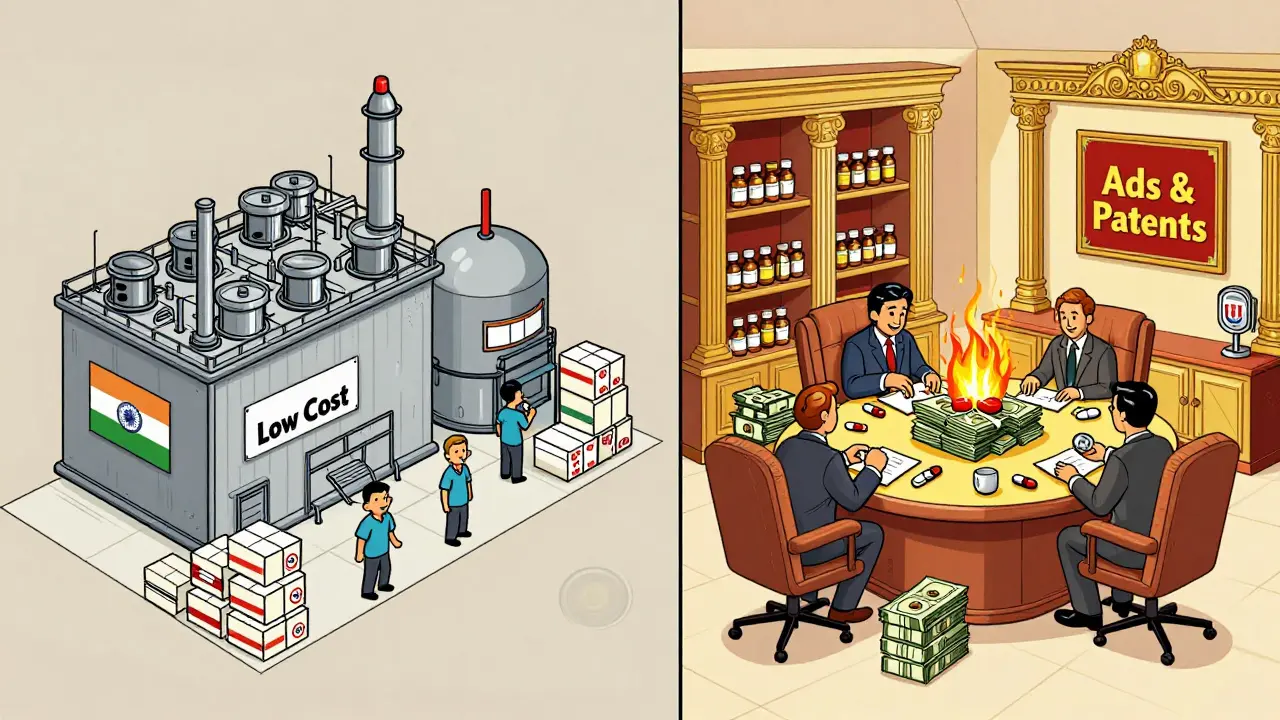
Are Generics Really Just as Safe and Effective?
Yes. The FDA doesn’t approve generics based on trust. They require rigorous testing. A generic must prove it delivers the same amount of medicine into your blood as the brand - within 80% to 125% of the original. That’s a tight range. It’s not “close enough.” It’s scientifically proven to be the same. There are rare exceptions. For drugs with a narrow therapeutic index - like warfarin, lithium, or levothyroxine - even tiny differences in absorption can matter. That’s why some doctors are cautious. But even here, the FDA has approved thousands of generic versions of these drugs with no increase in adverse events. The 2022 study from Johns Hopkins found that switching between generic versions of levothyroxine was safe for 99% of patients. One common myth: “My doctor says the brand works better.” In reality, most doctors don’t know the difference. A Harvard survey found that when patients were told generics are identical, 87% stopped worrying. Education works.Who’s Making These Generics - and Why Should You Care?
The U.S. generic drug market is dominated by a few big players: Teva, Viatris, and Amneal. But there are hundreds of smaller manufacturers, many based in India and China. That’s not a problem - it’s the reason prices stay low. More suppliers = more competition = lower prices. The FDA inspects every manufacturing facility - whether it’s in Ohio or Bangalore. In 2022, the FDA inspected over 3,500 generic drug plants. They shut down facilities that didn’t meet standards. The system isn’t perfect, but it’s monitored closely. And the market is growing. The global generic drug market is projected to hit $665 billion by 2029. More companies are entering. More drugs are becoming available as generics. That means more savings ahead.How to Get the Best Generic Deal
You don’t have to settle for the first generic your pharmacist hands you. Here’s how to save even more:- Ask your doctor to write “Dispense as Written” only if necessary. Otherwise, let them know you want the lowest-cost generic.
- Check the FDA’s Orange Book (you can search it online) to see which generics are rated AB (therapeutically equivalent).
- Use pharmacy discount programs. Walmart, Target, and Costco sell many generics for $4 or less per month.
- Ask your pharmacist if there’s a lower-cost alternative within the same drug class. Sometimes switching from one generic to another saves 90%.
- If you’re on Medicare, use the Plan Finder tool to compare out-of-pocket costs for different generics.
What’s Holding Back Even More Savings?
Despite all the progress, there are still barriers. Drug shortages hit generics hard - 78% of current shortages involve generic drugs. When a single factory has a quality issue, it can knock out supply for months. That’s why prices spike. Also, insurance plans sometimes don’t cover the cheapest generic. They might only cover one brand of a generic - even if another is cheaper. That’s called “formulary steering.” You have to ask. Call your insurer. Ask: “Is there a lower-cost generic I can switch to?” And then there’s the issue of copays. Even though generic drugs cost pennies to make, some insurers charge high copays to discourage switching - or to push you toward more expensive alternatives. That’s changing, though. The 2023 Inflation Reduction Act caps Medicare Part D out-of-pocket costs at $2,000 a year, which will push more people toward generics.Real Stories, Real Savings
On Reddit, one user shared: “I paid $450 a month for brand-name sertraline. Switched to generic? $9. Same effect. No side effects. I wish I’d done it years ago.” Another: “My dad takes three generics for heart disease. His monthly copay used to be $210. Now it’s $18. That’s a $2,300 annual savings. He’s still alive. And so is his bank account.” Consumer Reports found that 78% of people actively ask for generics. And 63% would switch pharmacies just to get a better price. That’s power. You have that power too.What’s Next?
Biosimilars - generic versions of complex biologic drugs like Humira and Enbrel - are starting to enter the market. As of 2023, 41 have been approved. They’re not as cheap as small-molecule generics yet, but they’re already saving $3.2 billion a year. That number will climb. Experts estimate that expanding therapeutic substitution - swapping one generic for a cheaper one with the same effect - could save another $15 billion annually. That’s like giving every American a $45 refund on their healthcare bill. The bottom line? Generics aren’t a compromise. They’re the smart choice. They’re safe. They’re proven. And they’re saving you money every time you fill a prescription.Are generic medications as effective as brand-name drugs?
Yes. The FDA requires generic drugs to be bioequivalent to their brand-name counterparts, meaning they deliver the same amount of active ingredient into your bloodstream at the same rate. Thousands of studies confirm they work the same way. The only differences are in inactive ingredients like fillers or dyes - which don’t affect how the medicine works.
Why do some people say generics don’t work for them?
Rarely, patients report differences when switching between generics - especially with drugs like levothyroxine or seizure medications, where tiny changes in blood levels matter. But studies show these cases are extremely uncommon. Often, the issue isn’t the generic itself, but switching between different generic manufacturers. If you notice a change, talk to your doctor. Don’t assume the generic is the problem - it’s usually the switch, not the drug.
Can pharmacists substitute generics without my doctor’s permission?
In 49 states, pharmacists can automatically substitute a generic unless the doctor writes “Dispense as Written” or “Brand Necessary.” New York is the only exception, requiring explicit permission. Always check your prescription label - if it says “generic substitution allowed,” your pharmacist can switch it.
Why are some generics more expensive than others?
It’s not about quality - it’s about supply and demand. If only one company makes a generic, they can charge more. When multiple manufacturers enter the market, prices drop. Sometimes, a generic version made by a smaller company costs 90% less than a similar one made by a larger one. Always ask your pharmacist: “Is there a cheaper version of this generic?”
Does Medicare cover generic drugs?
Yes. Medicare Part D plans cover generics, and they’re almost always the cheapest option. In fact, 91% of prescriptions filled for Medicare beneficiaries are generics. The 2023 Inflation Reduction Act caps out-of-pocket drug costs at $2,000 per year, making generics even more valuable for seniors.
Are generic drugs made in the U.S.?
About 80% of the active ingredients in U.S. generics come from overseas - mostly India and China. But every manufacturing facility, no matter where it’s located, must pass FDA inspections. The FDA inspects more than 3,500 generic drug plants each year. If a facility fails, it’s shut down - even if it’s in another country.



January 13, 2026 AT 23:14
Let’s be real - the FDA’s ‘bioequivalence’ standard is a joke. 80% to 125%? That’s a 45% swing in blood concentration. I’ve seen patients crash after switching generics - not because of ‘placebo effect,’ but because their bodies were suddenly flooded or starved of active ingredient. This isn’t ‘saving money,’ it’s pharmaceutical roulette. And don’t get me started on Indian factories with zero oversight - I’ve read the inspection reports. Half of them are barely above sewage levels. You think you’re saving $600 a year? You’re gambling with your liver, your kidneys, your life.
And don’t tell me ‘studies show no difference.’ Studies are funded by the same conglomerates that own the brand-name drugs and the generic manufacturers. Conflict of interest? More like conflict of conscience.