

When a child gets sick, giving the right amount of medicine isn't just about following a prescription-it's about survival. Too little and the infection won't clear. Too much and you could send them into a coma. In pediatric care, weight-based dosing isn't a suggestion-it's the only safe way to give drugs. And even then, it's not enough to just calculate it once. You need a second set of eyes, a second calculation, and sometimes even a third. This isn't about being extra careful. It's about preventing avoidable deaths.
Why Weight Matters More Than Age
For decades, doctors guessed doses based on a child's age. "Give half the adult dose for a 6-year-old." But kids aren't just small adults. Their bodies process drugs differently. A newborn's liver can't break down medications like a teenager's. A toddler's kidneys filter drugs slower than a 10-year-old's. Even body water content changes: neonates are 75% water, while adults are only 60%. That means a drug that dissolves in water-like amoxicillin-spreads farther in a baby's body than in a teen's. If you dose by age, you're flying blind. The data doesn't lie. A 2022 study in Pediatrics found that using weight-based dosing cuts medication errors by 43% compared to age-based estimates. That's not a small improvement. That's life or death. One study tracked 87,342 pediatric doses and found that when two trained staff members independently verified the dose, serious errors dropped by 68%. That's not luck. That's a system that works.The Three-Step Formula Everyone Must Know
There's a simple, repeatable method used in every children's hospital in the world. It's not complicated, but it has to be done exactly right.- Convert pounds to kilograms. Use the exact conversion: 1 kg = 2.2 lb. Never round until the very end. If a child weighs 22 pounds, divide by 2.2. That’s 10 kg. Not 9.9, not 10.1. Exactly 10. Rounding too early causes cascading errors.
- Calculate total daily dose. Multiply the child's weight in kg by the prescribed dose per kg. For example, if the order is 40 mg/kg/day for amoxicillin and the child weighs 10 kg: 10 × 40 = 400 mg/day.
- Divide by frequency. If it's given twice a day, split the daily dose: 400 mg ÷ 2 = 200 mg per dose.
This seems basic. But here’s the catch: in 2022, the Institute for Safe Medication Practices found that 32% of all pediatric dosing errors came from one thing-messing up the pound-to-kilogram conversion. Nurses mixed up pounds and kilograms. Residents wrote "22 lb" and assumed it was 22 kg. That’s a 10-fold overdose. It happens more than you think.
Double-Checks: The Non-Negotiable Safety Net
You don’t trust one person to check a dose. You don’t even trust two people to do it alone. You make them do it separately. The Joint Commission’s National Patient Safety Goal 01.01.01 requires two independent verifications for high-alert medications in children. That means two registered nurses, each doing the math on their own, using their own calculator, writing it down separately. Then they compare. If the numbers don’t match, they stop. No exceptions. One nurse in Melbourne told me about a near-miss last year. A resident ordered 200 mg of amoxicillin for a 10 kg child. The calculated safe dose was 200 mg per dose (40 mg/kg × 10 kg = 400 mg/day ÷ 2 = 200 mg). But the resident wrote "200 mg" without specifying it was per dose. The nurse caught it because the daily total would have been 400 mg, which is within range. But then she checked the weight: the child was 10 kg, so 40 mg/kg/day meant 400 mg total. That’s correct. But then she looked at the label: the vial was labeled "100 mg/mL". If they gave 200 mg per dose, that’s 2 mL. The nurse knew the max dose per administration was 15 mL for safety. But then she noticed: the order said "twice daily". So 200 mg twice = 400 mg/day. That matched. So she thought it was fine. Until the second nurse checked the math again. The resident had accidentally written "200 mg" when they meant "20 mg". The nurse caught it because the dose was 10 times higher than expected. That’s the power of double-checking.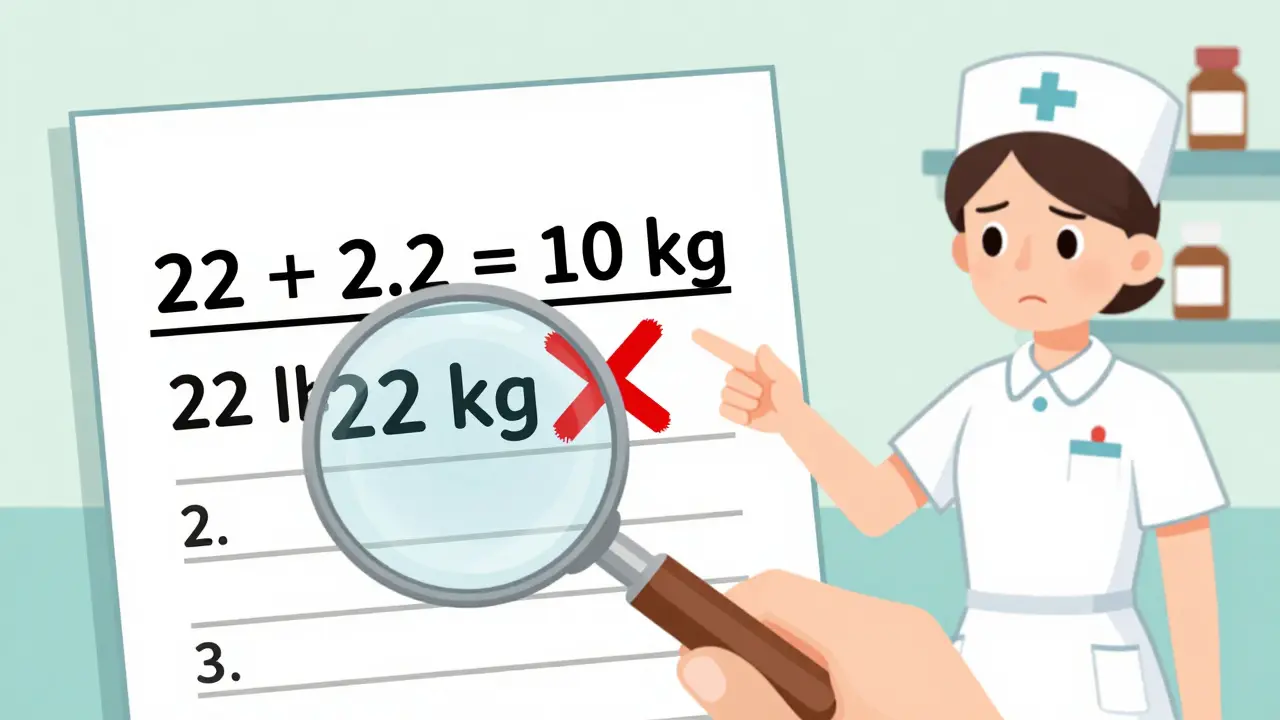
When Weight Isn’t Enough
Weight-based dosing works for most drugs. But not all. For chemotherapy drugs, body surface area (BSA) is more accurate. The Mosteller formula-√(weight in kg × height in cm ÷ 3600)-is used because cancer drugs affect tissue differently. A 2021 study showed BSA dosing was 18% more accurate than weight alone for chemo. But it adds time: 47 seconds longer per dose. That’s why it’s reserved for high-risk drugs. For obese children, weight alone can be misleading. A child with a BMI over the 95th percentile has more fat tissue and less lean muscle. For water-soluble drugs (like antibiotics), you use adjusted body weight: ideal body weight + 0.4 × (actual weight - ideal weight). For fat-soluble drugs (like some anticonvulsants), you use actual weight. The Pediatric Endocrine Society recommends this, and 78% of children's hospitals follow it. And for babies under 6 months? Weight doesn’t tell the whole story. Premature infants have underdeveloped kidneys. A 2 kg baby might need 40-60% less of an aminoglycoside than a 2 kg full-term infant, even if the weight is the same. That’s because their kidneys can’t clear the drug fast enough. You have to know the gestational age, not just the scale reading.The Hidden Errors That Kill
The biggest mistakes aren’t about math. They’re about assumptions.- Unit confusion: 38% of errors come from mixing up mg and mcg, or pounds and kilograms. One nurse told me her hospital now puts bright red stickers on all scales: "WEIGH IN KG ONLY."
- Decimal errors: 27% of errors are from misplaced decimals. Writing 10.0 mg instead of 1.0 mg. Or 200 mg instead of 20 mg. Electronic health records now flag doses that are 10% above or below expected ranges. That’s how the University of California San Francisco cut errors by 52%.
- Ignoring organ function: 19% of errors happen when renal or liver impairment isn’t considered. A child with kidney disease needs lower doses-even if they weigh the same as a healthy child.
It’s not enough to have the right formula. You need systems that catch mistakes before they reach the child.

What’s Changing Now
Technology is helping. Epic Systems rolled out pediatric dosing modules in June 2023 that auto-calculate weight-based doses and block unsafe orders. It’s now in 78% of children’s hospitals. The NIH’s Pediatric Trials Network has enrolled 15,000 kids to build better dosing guidelines for 25 common drugs. And by 2025, the FDA will require all new drugs to include pediatric dosing algorithms. But the most important tool hasn’t changed. It’s still the human brain, working in pairs. The nurse who checks the math. The pharmacist who questions the order. The resident who pauses and says, "Wait, does this make sense?"There’s no magic app that replaces vigilance. No algorithm that replaces a second pair of eyes. The science is solid. The math is simple. What’s hard is staying sharp when you’re tired, when the room is loud, when the baby is crying, and the parents are begging for relief.
That’s why weight-based dosing isn’t just a calculation. It’s a culture. A habit. A promise.
What Every Provider Must Do
- Always weigh the child within 24 hours of giving medication. Never use an old weight.
- Convert pounds to kilograms using the exact 2.2 ratio. Round only after the final calculation.
- Double-check every dose-two independent calculations, no shortcuts.
- Know when to use adjusted body weight for obese children.
- For infants under 6 months, consider gestational age and organ maturity, not just weight.
- Use electronic alerts, but never rely on them alone.
Medication errors in children aren’t accidents. They’re system failures. And they’re preventable.




March 2, 2026 AT 21:00
Just saw a kid get dosed wrong last month because the chart said 22 lbs and the nurse thought it was 22 kg. No one caught it until the med admin system flagged it. Scary stuff. We’ve all been there. One typo, one tired moment, and it’s over.
Weight-based dosing isn’t optional. It’s the bare minimum. The fact that we still have to argue this in 2024 is ridiculous.