
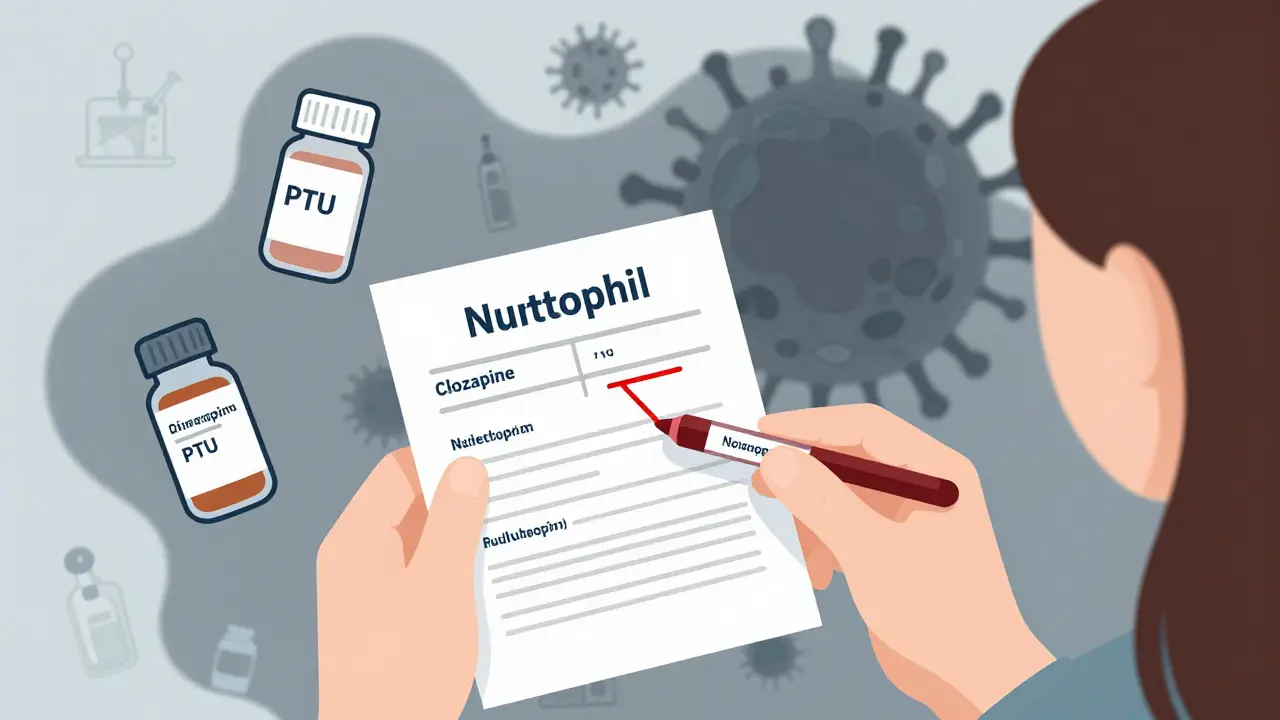
Neutrophil Count Monitor Tool
Calculate Your Neutrophil Count
This tool helps you understand your absolute neutrophil count (ANC) based on your blood test results. Critical for patients on high-risk medications.
When a drug you’re taking starts to silently shut down your body’s ability to fight infection, you won’t feel it right away. No rash. No nausea. Just a fever that won’t go away - and then, suddenly, you’re in the emergency room fighting for your life. This is agranulocytosis: a rare but deadly drop in white blood cells, specifically neutrophils, caused by certain medications. It’s not a guess. It’s not a theory. It’s a medical emergency that kills 10-20% of people if missed - and yet, it’s preventable.
What Exactly Is Agranulocytosis?
Agranulocytosis means your absolute neutrophil count (ANC) has crashed below 100 cells per microliter of blood. For context, a normal ANC is between 1,500 and 7,000. At 100 or lower, your immune system can’t respond to bacteria or fungi. Even a small cut or a sore throat can spiral into sepsis. This isn’t just low white blood cells - it’s the near-total collapse of your frontline defense. About 70% of all cases come from medications. That’s not rare. That’s common enough that doctors should be checking for it. The drugs that cause it don’t just randomly harm you - they either trigger your immune system to attack your own neutrophils, or they poison the bone marrow where these cells are made. The result is the same: you’re defenseless.Which Medications Are the Biggest Risks?
Not all drugs are equal. Some carry a tiny risk. Others are ticking time bombs. The top offenders are well-documented:- Clozapine - Used for treatment-resistant schizophrenia. The risk is 0.77% (about 8 in 1,000 people). That sounds low, but for someone with no other options, the trade-off is worth it - if they’re monitored. The FDA requires weekly blood tests for the first 6 months. Miss one test, and your risk jumps.
- Propylthiouracil (PTU) - An antithyroid drug. Risk is 0.3-0.5 per 10,000 patient-years. Methimazole is safer, but PTU is still used, especially in early pregnancy.
- Trimethoprim-sulfamethoxazole - A common antibiotic. It increases your risk of agranulocytosis 15.8 times compared to other antibiotics.
- Dipyrone - A painkiller banned in the U.S. but still used elsewhere. Risk is 1.2 per 10,000 patient-years.
How Do You Know It’s Happening?
Symptoms don’t appear until it’s too late. By then, you’re already sick. The most common signs are:- Fever over 38.3°C (101°F)
- Sore throat or mouth ulcers
- Chills or fatigue
- Swollen gums or difficulty swallowing
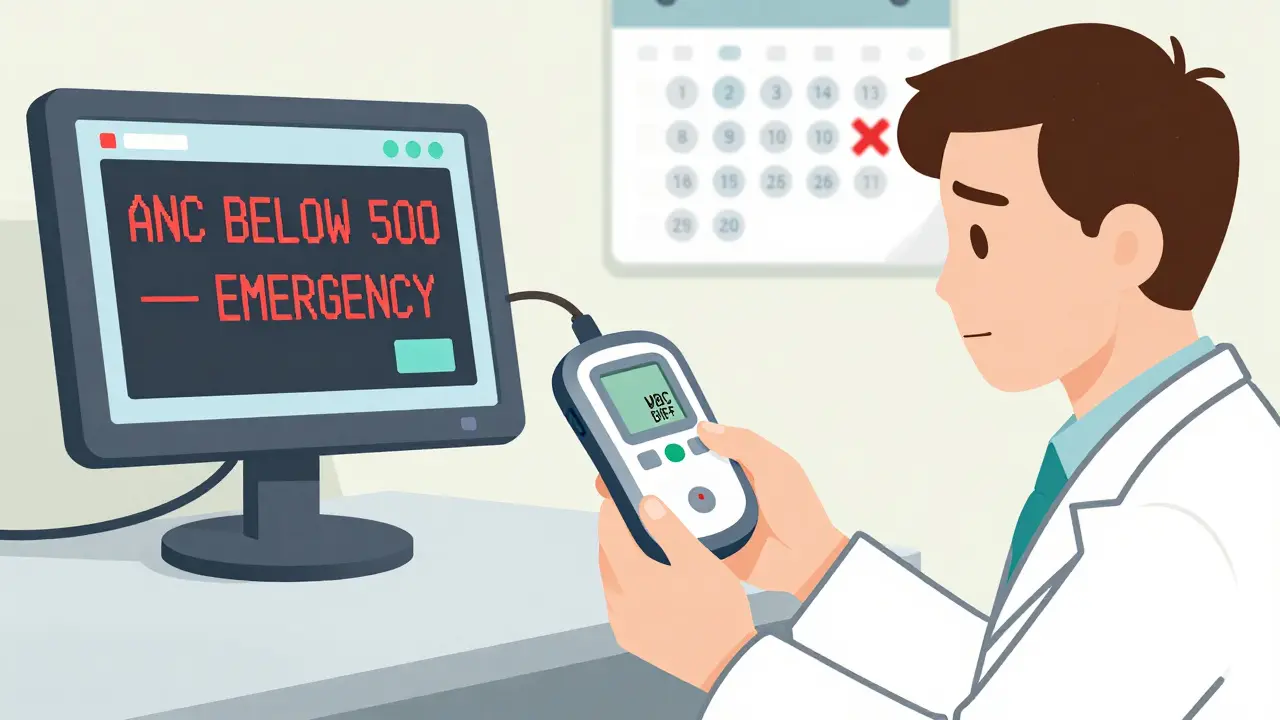
Monitoring: The Only Way to Survive
This is where most people fail. Monitoring isn’t optional. It’s life-saving. For clozapine, the rules are strict:- Weeks 1-6: Weekly blood tests
- Weeks 7-26: Every two weeks
- After 6 months: Monthly
What Happens If You Get It?
Stop the drug immediately. That’s step one. Recovery usually takes 1-3 weeks once the medication is out of your system. But while you’re waiting, you’re vulnerable. The Infectious Diseases Society of America says: if you’re febrile and neutropenic (ANC <500), start broad-spectrum antibiotics right away - especially ones that cover Pseudomonas aeruginosa. This single step cuts mortality from 21% to under 6%. Hospitalization is almost always required. No home remedies. No waiting it out. You need IV antibiotics, isolation, and constant monitoring. Delaying treatment by 48 hours doubles your risk of death.Why Do Some People Get It and Others Don’t?
It’s not random. Genetics matter. In 2023, the FDA approved the first genetic test for clozapine-induced agranulocytosis: the HLA-DQB1*05:02 test. If you carry this gene variant, your risk is 14.3 times higher. It doesn’t mean you’ll definitely get it - but it tells you to be extra cautious. Some people develop it after years of use. Others, after just a week. There’s no pattern. That’s why monitoring can’t be based on how long you’ve been on the drug. It has to be scheduled, consistent, and non-negotiable.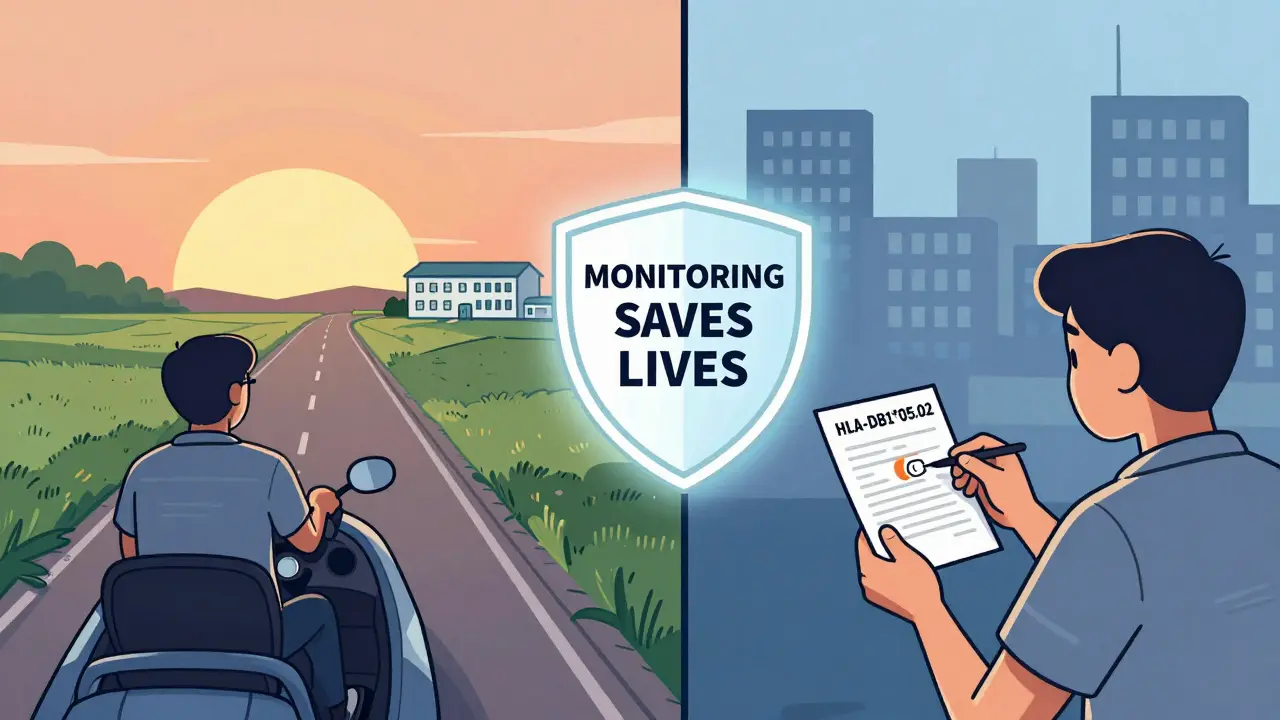
Global Gaps and Inequalities
In Germany, 98.7% of patients on high-risk drugs are monitored properly. In low-income countries, only 32% have access to basic blood testing. In rural Australia, a patient might drive 200 kilometers for a blood draw. If they miss one, the system doesn’t catch it. A 2023 CDC report found rural and underserved populations die from this condition 2.3 times more often. It’s not because they’re sicker. It’s because they can’t get tested in time.What’s Next?
The future is smarter monitoring. AI-powered alerts in electronic health records can now flag missed blood tests, predict risk based on drug combinations, and remind doctors before they prescribe. A 2022 study showed these systems reduced missed cases by 47%. By 2028, the Personalized Medicine Coalition predicts 40% of high-risk medications will require genetic screening before use. That’s not science fiction. It’s coming fast.Bottom Line: Don’t Wait for Symptoms
If you’re on clozapine, PTU, trimethoprim-sulfamethoxazole, or any other high-risk drug, your blood count isn’t just a formality. It’s your shield. Skipping a test isn’t being busy - it’s gambling with your life. Fever? Sore throat? Fatigue? If you’re on one of these drugs, assume it’s agranulocytosis until proven otherwise. Tell your doctor you’re on a high-risk medication. Demand a CBC. Don’t let them brush it off. This isn’t about scaring you. It’s about giving you control. Agranulocytosis is rare. But when it hits, it hits hard. And if you’re taking the right drugs, with the right monitoring, you can live a full life - without becoming a statistic.Can agranulocytosis be reversed?
Yes, if caught early. Stopping the offending medication allows the bone marrow to recover in most cases, usually within 1 to 3 weeks. However, recovery depends on how quickly treatment begins. Delaying care increases the risk of fatal infection. Blood transfusions and growth factors like G-CSF may be used to speed recovery, but the most critical step is discontinuing the drug.
Is agranulocytosis the same as neutropenia?
No. Neutropenia means your neutrophil count is below 1,500 per microliter - which is common with many medications and often mild. Agranulocytosis is the most extreme form, with counts below 100. It’s not just low - it’s dangerously low. While neutropenia may cause minor symptoms, agranulocytosis is a medical emergency that can lead to rapid, life-threatening infection.
Can I still take clozapine if I have a family history of agranulocytosis?
Yes - but only with genetic testing. The HLA-DQB1*05:02 gene variant increases your risk 14-fold. If you carry it, your doctor may avoid clozapine or implement stricter monitoring. Even if you don’t have the gene, weekly blood tests are still required. Family history alone doesn’t determine risk - genetics do. Testing is now standard before starting clozapine in many countries.
How often should I get blood tests if I’m on a high-risk medication?
It depends on the drug. For clozapine: weekly for the first 6 months, then every two weeks for the next 6 months, then monthly. For propylthiouracil: monthly for the first 6 months, then every 2-3 months. For antibiotics like trimethoprim-sulfamethoxazole, routine monitoring isn’t standard - but if you’re on it for more than 2 weeks and develop fever or sore throat, get tested immediately. Always follow your doctor’s protocol - never assume all high-risk drugs have the same schedule.
What should I do if I miss a blood test?
Call your prescriber immediately. Do not skip the next test. Missing one test increases your risk of undetected agranulocytosis. If you’re on clozapine, your pharmacy may not refill your prescription until the test is done - that’s intentional. If you can’t get to a lab, ask about point-of-care testing options like Hemocue. Never restart a high-risk drug without a recent ANC result.
Are there alternatives to clozapine for treatment-resistant schizophrenia?
Yes, but none are as effective. Olanzapine, risperidone, and long-acting injectables are alternatives, but they often fail where clozapine works. Clozapine is uniquely effective for patients who haven’t responded to at least two other antipsychotics. Because of this, many doctors consider it the last option - and the most important one. The key isn’t avoiding clozapine - it’s managing its risks properly through strict monitoring and genetic screening.







January 29, 2026 AT 18:29
Just read this and had to pause. I work in pharmacy and we get these alerts all the time - clozapine monitoring is non-negotiable. If a patient misses a blood draw, we literally can’t dispense. It’s not bureaucracy. It’s the only thing keeping them alive.
And yeah, 68% compliance? That’s terrifying. Someone’s getting sick because someone else skipped a lab.